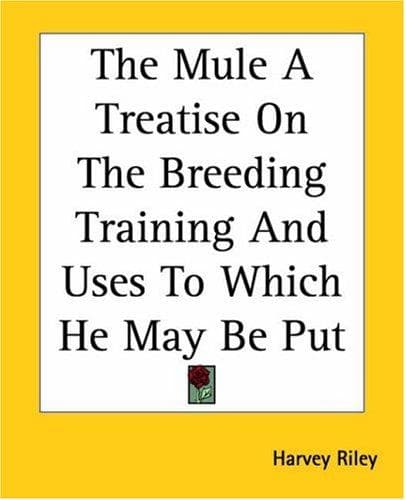
The Mule: A Treatise on the Breeding, Training, and Uses to Which He May Be PutRiley, Harvey
History
The Mule: A Treatise on the Breeding, Training, and Uses to Which He May Be Put
Riley, Harvey
Mules
_Mule Raising_.--I never could understand why it was that almost every
person, that raises stock, recommends big, ugly gollips of mares, for
mule-breeding. The principle is certainly a wrong one, as a little study
of nature must show. To produce a good, well-proportioned mule, you must
have a good, compact, and serviceable mare. It is just as necessary as
in the crossing of any other animal. It certainly is more profitable to
raise good animals than poor ones; and you cannot raise good mules from
bad mares, no matter what the jack is. You invariably see the bad mare
in the flabby, long-legged mule.
It has been held by some of our officers, that the mule was a better
animal for Government service, because he required less care and feed
than the horse, and would go longer without water. This, again, is a
grave mistake. The mule, if properly taken care of, requires nearly as
much forage as the horse, and should be groomed and cared for just the
same. I refer now to team animals. Such statements do a great deal of
injury, inasmuch as they encourage the men who have charge of animals to
neglect and abuse them. The teamster who hears his superior talk in this
way will soon take advantage of it. Animals of all kinds, in a wild and
natural state, have a way of keeping themselves clean. If left wild, the
mule would do it. But when man deprives them of the privileges by tying
them up and domesticating them, he must assist them in the most natural
way to keep themselves clean. And this assistance the animal appreciates
to its fullest extent.
_How to Handle a Mule Colt._--Owners and raisers of mules should pay
more attention to their habits when young. And I would give them this
advice: When the colt is six months old, put a halter on him and let the
strap hang loose. Let your strap be about four feet long, so that it
will drag on the ground. The animal will soon accustom himself to this;
and when he has, take up the end and lead him to the place where you
have been accustomed to feed him. This will make him familiar with you,
and increase his confidence. Handle his ears at times, but don't squeeze
them, for the ear is the most sensitive part of this animal. As soon as
he lets you handle his ears familiarly, put a loose bridle on him. Put
it on and take it off frequently. In this way you will secure the colt's
confidence, and he will retain it until you need him for work.
Public-domain text, read in full here on John Shaqi.
Reviews
Reviews
No reviews yet
Be the first to share your thoughts on this work.
Join the Discussion
Join the discussion
Sign in to leave a comment or review.
Sign InorCreate an account