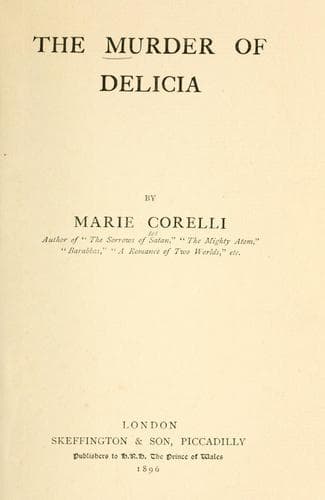
Detective and mystery stories; English fiction -- 19th century
I have purposely selected the case of ‘Delicia’ from several more or
less similar ones as a type of the fate frequently meted out by men to
the women who have by their own intellectual attainments succeeded in
winning fame and fortune. There are three radical errors chiefly made
by the ‘superior’ sex in their hasty estimation of what are called
‘clever’ women;—the first on the question of heart; the second in the
matter of permanence; and the third on the always momentous
consideration of good looks. If a woman does anything out of the common
in the way of art or literature, she is immediately judged by men as
being probably without tenderness, without permanence in her work, and
certainly without personal beauty. Now, as far as tenderness goes, a
woman who thinks, who has read much and has studied human life in its
various wonderful and often sad aspects, is far more able to realise the
rareness and the worth of true love than the woman who has never thought
or studied at all. She,—the woman thinker,—understands with full pathos
the real necessity there is for being kind, patient and forbearing one
with the other, since at any moment Death may sever the closest ties and
put an end to the happiest dreams; and in her love—if she does
love—there must needs be far more force, truth and passion than in the
light emotion of the woman who lives for society alone, and flits from
pleasure to pleasure like a kind of moth whose existence and feeling are
but for a day. On the question of permanence in her work, she is the
equal of man, as permanence in both ambition and attainment depends
chiefly on temperament. A man’s work or fame may be as unstable as that
of any weak woman if he himself is unstable in nature. But put man and
woman together,—start them both equally with a firm will and a
resoluteness of endeavour, the woman’s intellect will frequently
outstrip the man’s. The reason of this is that she has a quicker
instinct and finer impulses. And lastly, on the subject of good
looks,—it is not a _sine qua non_ that a clever woman must be old and
must be ugly. It sometimes happens so,—but it is not always so. She
may be young and she may be lovely; nevertheless, men prefer to run
after the newest barmaid or music-hall dancer, who is probably painted
up to the eyes, and whose figure is chiefly the result of the
corset-maker’s art, under the impression that in such specimens alone of
our sex will they find true beauty. Were they told that a certain
artist who painted a certain great picture was a young and beautiful
woman, they would never believe it; if someone volunteered the
information that the sculptor whose massive marble group of classic
figures adorns one of the galleries in Rome was a woman whose smile was
ravishing and whose figure was a model for Psyche, they would shrug
their shoulders incredulously. ‘No, no!’ they would say, ‘Clever women
are always ‘unsexed,’—give me the barmaid—the shop-girl—the dancer—the
Public-domain text, read in full here on John Shaqi.
Reviews
Reviews
No reviews yet
Be the first to share your thoughts on this work.
Join the Discussion
Join the discussion
Sign in to leave a comment or review.
Sign InorCreate an account