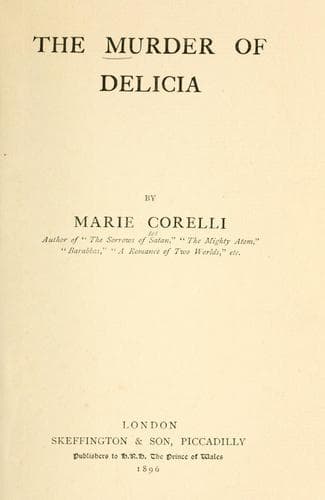
Detective and mystery stories; English fiction -- 19th century
‘living picture’—the aerial gymnast—give me anything rather than a pure,
finely-cultured, noble-natured woman to be the mother of my sons!’
Thus things drift; badly for England, if we are to believe all we are
told by scientific physiologists,—and whether these wiseacres and
doom-prophets are wrong or right in their prognostications, it is
certain that the true intention of Woman’s destiny has not yet been
carried out. She is fighting towards it,—but, if I may venture to say
so, she is using her weapons wildly and in various wrong directions. It
is not by opposing herself to man that she can be his real
helpmeet,—neither is it by supporting him on her money, whether such
money be earned or inherited. She will never make a true man of him
that way. And it is not by adopting his pastimes or apeing his manners.
It is by cultivating and cherishing to the utmost every sweet and sacred
sentiment of womanhood,—every grace, every refinement, every beauty; by
taking her share in the world’s intellectual work with force, as well as
with modesty, and by showing a faultless example of gentle reserve and
delicate chastity. When she is like this, it is of course highly
probable that she will be ‘murdered’ often as ‘Delicia’ was;—but the
death of many martyrs is necessary to the establishment of a new creed.
When man begins to understand that woman is not meant to be a toy or a
drudge, but a comrade,—the closest, best and truest that God has given
him,—then the clouds will clear; and marriage will be a blessing instead
of (as it too often proves) a curse,—and there will be few, if any,
‘Delicias’ to be slain, inasmuch as there will be few, if any men left,
so unworthy of their manhood as to play coward and traitor to the women
who trust them.
MARIE CORELLI.
July 6th, 1896.
*The Murder of Delicia*
*CHAPTER I*
A flood of warm spring sunshine poured its full radiance from the south
through the large, square lattice-window of Delicia’s study, flashing a
golden smile of recognition on Delicia herself and on all the objects
surrounding her. Gleaming into the yellow cups of a cluster of
daffodils which stood up, proudly erect, out of a quaint, brown vase
from Egypt, it flickered across a pearl-inlaid mandoline that hung
against the wall, as though it were playing an unheard melody in
delicate _tremolo_ on the strings; then, setting a crown of light on
Delicia’s hair, it flung an arrowy beam at the head of Hadrian’s
‘Antinous,’ whose curved marble lips, parted in an inscrutable,
half-mocking smile, seemed about to utter a satire on the ways of women.
Delicia had purchased this particular copy of the original bust in the
British Museum because she imagined it was like her husband. No one
else thought it in the least like him—but she did.
Public-domain text, read in full here on John Shaqi.
Reviews
Reviews
No reviews yet
Be the first to share your thoughts on this work.
Join the Discussion
Join the discussion
Sign in to leave a comment or review.
Sign InorCreate an account