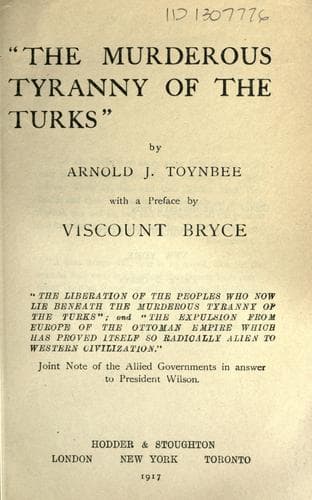
"The Murderous Tyranny of the Turks"Toynbee, Arnold
History
"The Murderous Tyranny of the Turks"
Toynbee, Arnold
Eastern question; Turkey -- Politics and government
The province for which Mr. Gladstone pleaded was Bulgaria; but since
Bulgaria has been freed, the other peoples who have still remained under
the tyranny have suffered horrors infinitely worse in their extent and
their iniquity than those which in 1876 aroused the indignation of the
world.
Heinrich von Treitschke loved many things more than liberty, but the
profanation of liberty by the Turk drew from him a denunciation as
strong as Gladstone’s own. “_A near future_,” he writes, “_will, it is
to be hoped, blot out the scandal that such heathendom should ever have
established itself on European soil. What has this Turkish Empire done in
three entire centuries? It has done nothing but destroy._”
Treitschke and Gladstone, men who stood for very different ideals in
Europe, both called with one voice for liberation from the Turk; and the
Allies are struggling now to bring what they strove for to completion.
THE PRINCIPLE OF NATIONALITIES.
In the settlement of Turkey, conspicuously, the Allies will be crowning
a historic task, at which they themselves have laboured in former
times. The _liberation of the subject peoples of Turkey_, and the
_reorganisation upon the principle of nationalities_ of countries under
the Sultan’s _murderous tyranny_, began a century ago with the national
struggles for independence of the Serbs and Greeks—struggles which were
part of the general struggle for freedom in Europe, and which gave
inspiration to the people of other subject lands. England, France and
Russia stepped in in 1827 to secure Greece the reward of her heroism when
she was almost succumbing to her oppressor; Russia compelled Turkey to
recognise Serbian autonomy in her treaty of peace with Turkey in 1831;
Russia again, by taking up arms in 1877, freed Rumania and Serbia from
Turkish suzerainty, liberated more of their oppressed brethren for Serbia
and Greece, and restored Bulgaria to national existence. In the Balkan
War of 1912-13, the Balkan nations carried on the work by their unaided
strength, and expelled the Ottoman Empire from all the provinces over
which it still tyrannised in Europe, with the exception of Constantinople
and Thrace. In 1916, the Sherif of Mecca, at the opposite extremity of
the Ottoman conqueror’s domain, liberated an Arab province and the Holy
Arab City of which he is the legitimate head. It is for the Entente to
liberate the Arabs of Syria and the Armenians, who cannot save themselves.
Public-domain text, read in full here on John Shaqi.
Reviews
Reviews
No reviews yet
Be the first to share your thoughts on this work.
Join the Discussion
Join the discussion
Sign in to leave a comment or review.
Sign InorCreate an account