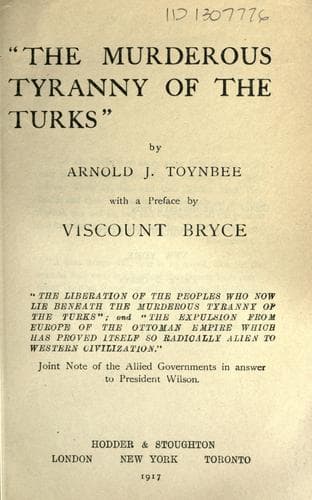
"The Murderous Tyranny of the Turks"Toynbee, Arnold
History
"The Murderous Tyranny of the Turks"
Toynbee, Arnold
Eastern question; Turkey -- Politics and government
The Syrians and Armenians have not, as the Turks and Germans allege,
been disloyal to Turkey in her hour of danger. The Arab and Armenian
conscripts have fought dutifully for a cause not their own in the Balkan
War and in the present more terrible conflict. Their leaders are too
prudent and the people too peaceable, their stake is too great, their
forces are too scattered, to allow them for a moment to contemplate
rising in arms. But their loyal and straightforward conduct has not
preserved them from the ferocity of their Turkish rulers; it has only
exposed them to a cold-blooded scheme of extermination which the
Young Turks are prosecuting at this moment with all their might. The
redemption of these innocent peoples from the hell into which they have
been cast, and where they will remain in agony so long as Ottoman and
Prussian militarism holds out, is incumbent upon the Allies if they are
to redeem their plighted word.
CONSTANTINOPLE.
This is what the Allies owe in the settlement of Turkey to the _principle
of nationalities_. But they are further pledged to vindicate _the right
which all peoples, whether small or great, have to the enjoyment of full
security and free economic development_, and this touches the status of
Constantinople.
Constantinople, since the Turks conquered it from its last Christian
Emperor in 1453, has been the political capital of the Ottoman Empire.
But ever since it has been a city at all, it has also been the
strategical and economic key to the Black Sea, conditioning the security
and dominating the economic development of all peoples bordering on the
Black Sea coasts. It is the most cosmopolitan city in the world. It is
the Turk’s at present by right of conquest, but that right justifies his
expulsion by war if it justifies his original intrusion, and on broader
considerations of population, sentiments, traditions and monuments of
the past, Constantinople is more truly the capital of all the Christian
peoples of the East. But it is not the exclusive possession of any of
its native inhabitants, whether their presence there dates from more
ancient or from comparatively recent times. The most important quarter
in Constantinople is Pera, across the Golden Horn, which is inhabited by
a foreign mercantile community, as international in its composition as
the mercantile community in the Chinese “Treaty Port” of Shanghai. The
chief volume of the transit trade which gives Constantinople its rank
as a port, passes through these foreign residents’ hands. But even they
are not the parties most vitally concerned in the economic status of
Constantinople and the Straits. If conditions do not suit them, they can
transfer their business elsewhere. The parties to whom the destiny of
Constantinople is a matter of life and death are Russia and Rumania, two
countries bound for ever by their geographical position to conduct their
maritime trade through the Black Sea and the Straits that give entrance
Public-domain text, read in full here on John Shaqi.
Reviews
Reviews
No reviews yet
Be the first to share your thoughts on this work.
Join the Discussion
Join the discussion
Sign in to leave a comment or review.
Sign InorCreate an account