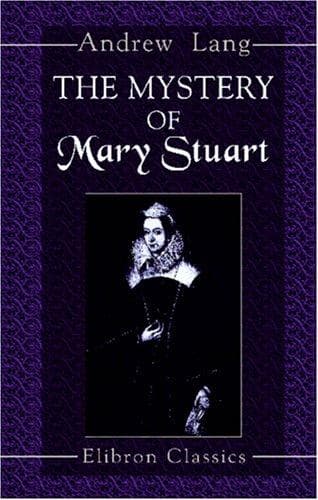
Mary, Queen of Scots, 1542-1587; Queens -- Scotland -- Biography; Scotland -- History -- Mary Stuart, 1542-1567
The second _dramatis persona_ is Darnley, ‘The Young Fool.’ Concerning
Darnley but little is recorded in comparison with what we know of Mary. He
was the son, by the Earl of Lennox, a royal Stewart, of that daughter whom
Margaret Tudor, sister of Henry VIII., and widow of James IV., bore to her
second husband, the Earl of Angus. Darnley’s father regarded himself as
next to the Scottish crown, for the real nearest heir, the head of the
Hamiltons, the Duke of Chatelherault, Lennox chose to consider as
illegitimate. After playing a double and dishonest part in the troubled
years following the death of James V., Lennox retired to England with his
wife, a victim of the suspicions of Elizabeth.[6] The education of his
son, Henry, Lord Darnley, seems to have been excellent, as far as the
intellect and the body are concerned. The letter which, as a child of
nine, he wrote to Mary Tudor, speaking of a work of his own, ‘The New
Utopia,’ is in the new ‘Roman’ hand, carried to the perfection of
copperplate. The Lennox MSS. say that ‘the Queen was stricken with the
dart of love by the comliness of his sweet behaviour, personage, wit, and
vertuous qualities, as well in languages[7] and lettered sciencies, as
also in the art of music, dancing, and playing on instruments.’ When his
murderers had left his room at midnight, his last midnight, his
chamber-child begged him to play, while a psalm was sung, but his hand,
he replied, was out for the lute, so say the Lennox Papers. Physically he
was ‘a comely Prince of a fair and large stature, pleasant in countenance
... well exercised in martial pastimes upon horseback as any Prince of
that age.’ The Spanish Ambassador calls him ‘an amiable youth.’ But it is
plain that ‘the long lad,’ the _gentil hutaudeau_, with his girlish bloom,
and early tendency to fulness of body, was a spoiled child. His mother, a
passionate intriguer, kept this before him, that, as great-grandson of
Henry VII., and as cousin of Mary Stuart, he should unite the two crowns.
There were Catholics enough in England to flatter the pride of a future
king, though now in exile. This Prince _in partibus_, like his far-away
descendant, Prince Charles Edward, combined a show of charming manners,
when he chose to charm, with an arrogant and violent petulance, when he
deemed it safe to be insulting. At his first arrival in Scotland he won
golden opinions, ‘his courteous dealing with all men is well spoken of.’
As his favour with Mary waxed he ‘dealt blows where he knew that they
would be taken;’ he is said to have drawn his dagger on an official who
brought him a disappointing message, and his foolish freedom of tongue
gave Moray the alarm. It was soon prophesied that he ‘could not continue
long.’ ‘To all honest men he is intolerable, and almost forgetful of her
already, that has adventured so much for his sake. What shall become of
her or what life with him she shall lead, that already taketh so much
Public-domain text, read in full here on John Shaqi.
Reviews
Reviews
No reviews yet
Be the first to share your thoughts on this work.
Join the Discussion
Join the discussion
Sign in to leave a comment or review.
Sign InorCreate an account