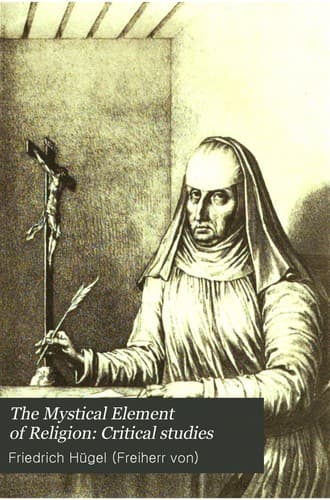
The Mystical Element of Religion, as studied in Saint Catherine of Genoa and her friends, Volume 2 (of 2)Hügel, Friedrich, Freiherr von
Religion
The Mystical Element of Religion, as studied in Saint Catherine of Genoa and her friends, Volume 2 (of 2)
Hügel, Friedrich, Freiherr von
Catherine, of Genoa, Saint, 1447-1510
And yet,--though this first impression has been held to be finally
true by large masses of Christians; although the Greek Fathers
predominantly, and, in the West, the great soul of an Augustine, and
the powerful but one-sided personalities of a Luther and a Calvin
have, in various degrees and ways, helped to articulate and all but
finally fix it for the general Christian consciousness: this view is
yielding, somewhat slowly but none the less surely, to the sense that
it is the Synoptic, the pre-Pauline tradition which contains the fuller
arsenal of the spiritual forces which have transfigured and which still
inspire the world of souls. This, of course, does not mean that the
Pauline-Joannine developments were not necessary, or are not abiding
elements towards the understanding of the Christian spirit.
And, to come to the true answer to our objection, such a judgment
does not mean that the reflective penetration and reapplication of
the original more spontaneous message was, from the very nature of
the case, inferior to the first less articulated announcement of the
Good Tidings. But it merely signifies that this necessary process of
reflection could only be applied to parts of the original, immensely
rich and varied, because utterly living, divinely spiritual, whole; and
that, thus, the special balance and tension which characterized the
original, complete spirit and temper, could, however profoundly, be
reproduced only in part. For the time being this later penetration and
resetting of some elements from among the whole of Our Lord’s divinely
rich and simple life and teaching, necessarily and rightly, yet none
the less most really, ignored, or put for the time into some other
context, certain other sides and aspects of that primitive treasure
of inexhaustible experience. Only the full, equable, and simultaneous
unfolding of all the petals could have realized the promise and
content of the bud; whereas the bud, holding enfolded within itself
such various elements and combinations of truth, could not expand its
petals otherwise than successively, hence, at any one moment only
somewhat one-sidedly and partially. Each and all of these unfoldings
bring some further insight into, and articulation of, the original
spiritual organism; and that they are not more, but less, than the
totality of that primitive experience and revelation, does not prove
that such reflective work is wrong or even simply dispensable,--for, on
the contrary, in some degree or form it was and ever is necessary to
the soul’s apprehension of that life and truth,--but simply implies the
immensity of the spiritual light and impulsion given by Our Lord, and
the relative smallness of even the greatest of His followers.
Public-domain text, read in full here on John Shaqi.
Reviews
Reviews
No reviews yet
Be the first to share your thoughts on this work.
Elsewhere in the archive
Join the Discussion
Join the discussion
Sign in to leave a comment or review.
Sign InorCreate an account