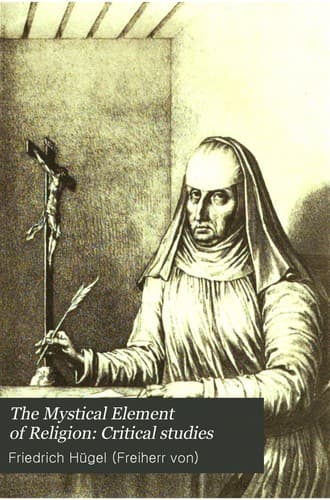
The Mystical Element of Religion, as studied in Saint Catherine of Genoa and her friends, Volume 2 (of 2)Hügel, Friedrich, Freiherr von
Religion
The Mystical Element of Religion, as studied in Saint Catherine of Genoa and her friends, Volume 2 (of 2)
Hügel, Friedrich, Freiherr von
Catherine, of Genoa, Saint, 1447-1510
Thus only if it could be shown that those parts of the New Testament
which doubtless give us the nearest approach to the actual words and
deeds of Our Lord require us to conceive them as having been without
the reflective and emotional element; or again that, in the case of the
more derivative parts of the New Testament, it is their reflectiveness,
and not their relative incompleteness and one-sidedness, that cause
them to be more readily englobed in the former world, than that former
world in the latter: could the facts here found be used as an argument
against the importance and strict necessity for religion of the
reflective and emotional, the “Subjective” elements, alongside of the
“Objective,” the Historical and Institutional ones.
It is a most legitimate ground for consolation to a Catholic when
he finds the necessities of life and those of learned research both
driving us more and more to this conclusion; for it is not deniable
that Catholicism has ever refused to do more than include the Pauline
and Joannine theologies amongst its earliest and most normative
stimulations and expressions; and that it has ever retained, far
more than Protestantism, the sense, which (upon the whole) is most
unbrokenly preserved by the Synoptists, of, if I may so phrase it, the
Christianity of certain true elements in the pre- and extra-Christian
religions. For it is in the Synoptists that we get the clear
presentation of Our Lord’s attitude towards the Jewish Church of His
time, as one, even at its keenest, analogous to that of Savonarola, and
not to that of a Luther, still less of a Calvin, towards the Christian
Church of their day.--Indeed in these documents all idea of limiting
Christianity to what He brought of new, appears as foreign to His mind
as it ever has been to that of the Catholic Church. Here we get the
most spontaneous and many-sided expression of that divinely human,
widely traditional and social, all-welcoming and all-transforming
spirit, which embraces both grace _and_ nature, eternity _and_ time,
soul _and_ body, attachment _and_ detachment. The Pauline strain stands
for the stress necessary to the full spiritualization of all those
occasions and materials, as against all, mere unregenerate or static,
retention of the simple rudiments or empty names of those things;
and predominantly insists upon grace, _not_ nature; eternity, _not_
time; soul, _not_ body; the cross and death here, the Crown and Life
hereafter. No wonder it is this latter strain that gets repeated,
with varying truth and success, in times of acute transition, and by
characters more antithetic than synthetic, more great at developing a
part of the truth than the whole.
Public-domain text, read in full here on John Shaqi.
Reviews
Reviews
No reviews yet
Be the first to share your thoughts on this work.
Elsewhere in the archive
Join the Discussion
Join the discussion
Sign in to leave a comment or review.
Sign InorCreate an account