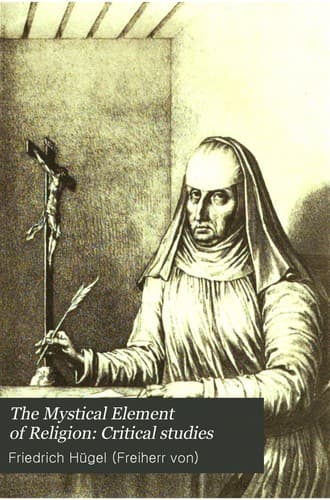
The Mystical Element of Religion, as studied in Saint Catherine of Genoa and her friends, Volume 2 (of 2)Hügel, Friedrich, Freiherr von
Religion
The Mystical Element of Religion, as studied in Saint Catherine of Genoa and her friends, Volume 2 (of 2)
Hügel, Friedrich, Freiherr von
Catherine, of Genoa, Saint, 1447-1510
Thinkers, of such wide historical outlook and unimpeachable detachment
from immediate controversial interest as Prof. Wilhelm Dilthey and
Dr. Edward Caird, have brought out, with admirable force, this
greater fulness of content offered by the Synoptists, and how the
Pauline-Joannine writings give us the first and most important of
those concentrations upon, and in part philosophic and mystical
reinterpretations of, certain constituents of the original happenings,
actions and message, as apprehended and transmitted by the first
eye-witnesses and believers.[112]--Here I would but try and drive
home the apparently vague, but in reality ever pressing and concrete,
lesson afforded by the clear and dominant fact of these two groups
within the New Testament itself:--of how no mere accumulation of
external happenings, or of external testimony as to their having
happened,--no amount of history or of institutionalism, taken as sheer,
purely positive givennesses,--can anywhere be found, or can anywhere
suffice for the human mind and conscience, in the apprehension and
embodiment of the truth. For although, in Our Lord’s most literally
transmitted sayings and doings, this continuous and inalienable element
of the apprehending, organizing, vitalizing mind and heart,--on
His part above all, but also on the part of His several hearers and
chroniclers,--can mostly still be traced and must everywhere be
assumed: yet it is in the Pauline-Joannine literature that the ever
important, the rightly and fruitfully “subjective,” the speculative and
emotional, the mystical and the volitional strain can best be studied,
both as to its necessity and as to its special character and dangers,
because here it is developed to the relative exclusion of the other
factors of complete religion.
4. _The exclusive emotionalism of Dionysius and Jacopone._
Now if even in St. Paul and St. John there is a strong predominance of
these reflective-emotional elements, in Dionysius and Jacopone they
threaten to become exclusive of everything else. Especially is this
the case with the Pseudo-Areopagite, steeped as he is in reflection
upon reflections and in emotion upon emotions, often of the most
subtle kind: a Christian echo, with curiously slight modifications,
of Neo-Platonism in its last stage,--hence, unfortunately, of the
over-systematic and largely artificial Proclus, instead of the
predominantly experimental and often truly sublime Plotinus. And even
Jacopone, although he has distinctly more of the historic element, is
still predominantly reflective-emotional, and presents us with many a
hardly modified Platonic or Stoic doctrine, derived no doubt from late
Graeco-Roman writers and their mediaeval Christian echoes.
5. _Catherine’s interpretation of the Gospel Ideal._
Public-domain text, read in full here on John Shaqi.
Reviews
Reviews
No reviews yet
Be the first to share your thoughts on this work.
Elsewhere in the archive
Join the Discussion
Join the discussion
Sign in to leave a comment or review.
Sign InorCreate an account