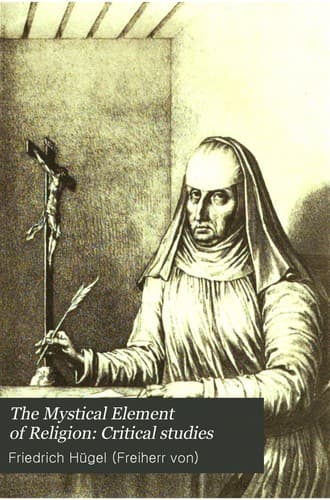
The Mystical Element of Religion, as studied in Saint Catherine of Genoa and her friends, Volume 2 (of 2) — John Shaqi
The Mystical Element of Religion, as studied in Saint Catherine of Genoa and her friends, Volume 2 (of 2)Hügel, Friedrich, Freiherr von
Religion
The Mystical Element of Religion, as studied in Saint Catherine of Genoa and her friends, Volume 2 (of 2)
Hügel, Friedrich, Freiherr von
Catherine, of Genoa, Saint, 1447-1510
And her emotional moods are analogously intense and rapidly shifting.
In the spring of 1510 “she cried aloud because of the great pain: this
attack lasted a day and a night”; in the night of August 10 “she tossed
about with many exclamations”; and at the beginning of September “she
cried out with a loud voice.” At other times, she laughs for joy. So at
the end of April “she would laugh without speaking”; on August 11 “she
fixed her eyes steadily on the ceiling; and for about an hour she abode
all but immovable, and spoke not, but kept laughing in a very joyous
fashion”; on August 17 great interior jubilation “expressed itself in
merry laughter”; and on the evening of September 7 “her joy appeared
exteriorly in laughter which lasted, with but small interruptions,
for some two hours.”--And her entire apparent condition would shift
from one such extreme to the other with extraordinary swiftness. In
the autumn of 1509 “she many times remained as though dead; and at
other times she would appear as healthy,--as though she had never had
anything the matter with her.” Already in December 1509 she herself,
after much vomiting and loss of blood, had sent for her Confessor and
had declared that “she felt as though she must die in consequence of
these many accidents.” Yet even on September 10, 1510, “when she was
not being oppressed and tormented by her accidents (attacks), she
seemed to be in good health; but when she was being suffocated by them,
she seemed as one dead.”[17]
II. CONCLUSIONS CONCERNING CATHERINE’S PSYCHO-PHYSICAL CONDITION DURING
THIS LAST PERIOD.
1. _Her illness not primarily physical. Her self-diagnosis._
Now we saw, at the beginning of this chapter, how readily her
attendants concluded, from all these extreme, multiple, swift-changing
and self-contradictory states, to their directly and separately
supernatural origin.--And indeed the diagnosis and treatment of her
case showed clearly that it was not primarily physical. So in the
case, probably in November 1509, of the cupping-glasses, when “she got
medically treated for a bodily infirmity, whilst her real trouble was
fire of the spirit”; so with a medicine given to her by the resident
Hospital physician, some time in April 1510, “from taking which she
nearly died”; so with Giovanni Boerio’s three-weeks’ treatment of her,
in May 1510, a treatment which led to no other results than momentary
additional distress; and so with the declaration of the ten Physicians
who, even on September 10, four days before her death, “could find no
trace of disease in her pulse, secretions, or any other symptom,” and
who consequently abstained from prescribing anything. And hence, more
or less throughout her last nine years, “there was confusion in the
management of her, not on her own part, but on that of those who served
her.”[18]
Public-domain text, read in full here on John Shaqi.
Reviews
Reviews
No reviews yet
Be the first to share your thoughts on this work.
Join the Discussion
Join the discussion
Sign in to leave a comment or review.
Sign InorCreate an account