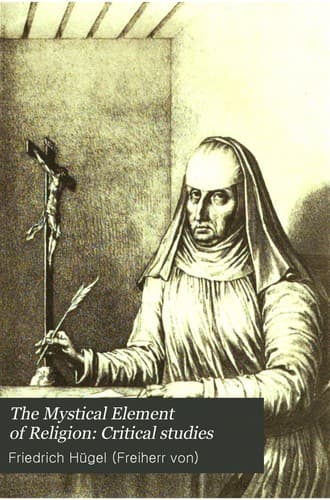
The Mystical Element of Religion, as studied in Saint Catherine of Genoa and her friends, Volume 2 (of 2)Hügel, Friedrich, Freiherr von
Religion
The Mystical Element of Religion, as studied in Saint Catherine of Genoa and her friends, Volume 2 (of 2)
Hügel, Friedrich, Freiherr von
Catherine, of Genoa, Saint, 1447-1510
For--and these two further points are of primary importance--the
tending of her, as distinct from physic, was throughout held by herself
to be of great importance; and yet this care was declared by her to
be often useless or harmful, owing to the powers of discrimination
possessed by her attendants being as much below their good-will, as her
own knowledge as to the differences between her healthy and _maladif_
states exceeded her power of herself acting upon this knowledge against
these sickly conditions. “She would often appear to be asleep; and
would awake from such a state, at one time, quite refreshed, and, at
another time, so limp and broken down as to be unable to move. Those
that served her knew not how to distinguish one state from the other;
and on recovering from an attack of the latter sort, she would say to
them: ‘Why did you let me continue in that state of quiet, from which
I have all but died?’” So, on September 5, “she cried aloud on waking
from a state of quiet, which had appeared to be (healthy) quietude, but
had not been so.” And indeed, already on January 10 previous, she had
shut herself off from her Confessor, “because it seemed to her that he
bore with her too much in her sayings and doings.”
Yet, at least after this time, Marabotto does oppose her sometimes.
Thus on two, somewhat later, occasions she respectively makes signs,
and asks, that Extreme Unction be given her; but only some four months
later did she actually receive it. In these cases, then, she either
had not, even at bottom, a correct physical self-knowledge; or her
requests had been prompted, at the time, by her secondary, _maladif_
consciousness alone.--When first visited by Boerio, she takes pleasure
in the thought of getting possibly cured by him; but “in the following
night, when great pain came upon her, she reproved herself, saying,
‘You are suffering this, because you allowed yourself to rejoice
without cause.’” But this declaration distinctly falls short of
any necessary implication of a directly supernatural origin of her
malady, as the _Vita_ here will have it, and but refers, either to the
continuance of earthly existence not deserving such joy, or to her
persistent fundamental consciousness that the phenomena were partly
the fruitful, profitable occasions, and partly the price paid, for the
mind’s close intercourse with things divine.
Public-domain text, read in full here on John Shaqi.
Reviews
Reviews
No reviews yet
Be the first to share your thoughts on this work.
Join the Discussion
Join the discussion
Sign in to leave a comment or review.
Sign InorCreate an account