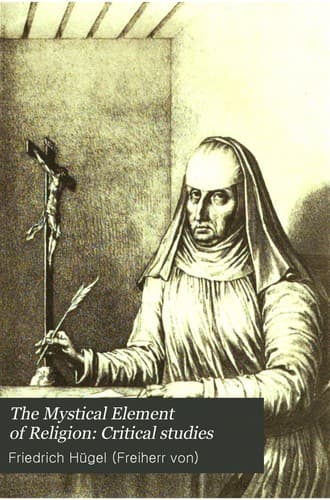
The Mystical Element of Religion, as studied in Saint Catherine of Genoa and her friends, Volume 2 (of 2)Hügel, Friedrich, Freiherr von
Religion
The Mystical Element of Religion, as studied in Saint Catherine of Genoa and her friends, Volume 2 (of 2)
Hügel, Friedrich, Freiherr von
Catherine, of Genoa, Saint, 1447-1510
(3) The third abuse is the neglect or contempt of morality, especially
on its social, visible, and physical sides. Particular Mystics, and
even whole Mystical schools and movements, have undoubtedly in some
instances, and have, possibly, in many more cases, been maligned on
this point, since even such a spotless life as Fénelon’s, and that of
such a profoundly well-intentioned woman as Madame Guyon, did not,
for a time, escape the most unjust suspicions. It is also true that,
as a man advances in spirituality, he lays increasing stress upon the
intention and general attitude of the agent, and increasingly requires
to be judged by the same interior standard, if he is to be rightly
understood at all. God may and does, to humble and purify him, allow
painful temptations and trials from within to combine, apparently,
against him, with persecutions and much isolation from without. And
the difference, rather than the similarity, between Religion and
Morality,--the sense of pure grace, of free pardon, of the strange
profound “givenness” of even our fullest willings and of our most
emphatically personal achievements,--can and should grow in him more
and more.
And yet it is clear that there must have been some fire to account
for all that smoke of accusation; that the material and the effect
outwards, the _body_ of an action, do matter, as well as does that
action’s _spirit_; that this body does not only act thus outwards,
but also inwards, back upon the spirit of the act and of the agent;
and that temptations and trials are purifying, not by their simple
presence but in proportion as they are resisted, or, if they have been
yielded to, in proportion as such defeats are sincerely deplored and
renounced. Thus everywhere the full development of any one part of
life, and the true unity of the whole, have to be achieved through the
gradual assimilation of at first largely recalcitrant other elements,
and within an ever-abiding multiplicity--a maximum number of parts and
functions interacting within one great organism. And hence not the
outrage, neglect, or supersession of morality, but, on the contrary,
its deeper development, by more precise differentiation from, and more
organic integration into, religion proper, must, here again and here
above all, be the final aim. Once more again it is the Incarnational
type which is the only fully true, the only genuinely Christian one.
Public-domain text, read in full here on John Shaqi.
Reviews
Reviews
No reviews yet
Be the first to share your thoughts on this work.
Elsewhere in the archive
Join the Discussion
Join the discussion
Sign in to leave a comment or review.
Sign InorCreate an account