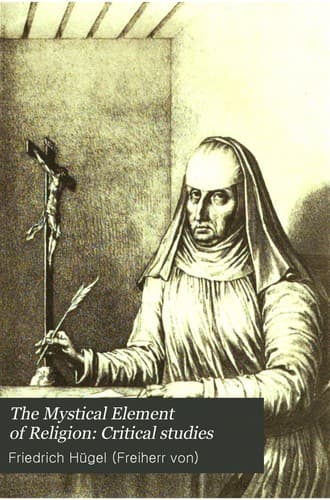
The Mystical Element of Religion, as studied in Saint Catherine of Genoa and her friends, Volume 2 (of 2)Hügel, Friedrich, Freiherr von
Religion
The Mystical Element of Religion, as studied in Saint Catherine of Genoa and her friends, Volume 2 (of 2)
Hügel, Friedrich, Freiherr von
Catherine, of Genoa, Saint, 1447-1510
(4) And, finally, there are certain hardly classifiable fanaticisms,
which are nevertheless a strictly logical consequence from a wrongly
understood Quiet and Passivity,--from Quietism in its unfavourable,
condemned sense. I am thinking of such a case as that of Margarethe
Peters, a young Quietist, who caused herself to be crucified by her
girl-companions, at Wildenspuch, near Schaffhausen, in 1823,--in order
to carry out, in full literalness and separateness, the utmost and
most painful passivity and dependence and resistless self-donation, in
direct imitation of the culminating act of Christ’s life on earth and
of His truest followers.[124] Here, in the deliberate suicide of this
undoubtedly noble Lutheran girl, we get an act which but brings out
the strength and weakness of Quietism wherever found. For the greatest
constituents of the Christian spirit are undoubtedly there: free
self-sacrifice, impelled by love of God, of Christ, and of all men,
and by hatred of self.--Yet, because they here suppress other, equally
necessary, constituents, and are out of their proper context and bereft
of their proper checks, they but render possible and actual a deed of
piteous self-delusion. How terrible is false simplification, the short
cut taken by pure logic, operating without a sufficient induction from
facts, and within an ardent, self-immolating temperament!
4. _Rome’s condemnation of Quietism._
All this is abundantly sufficient to explain and justify Rome’s
condemnation of Quietism. The term “Quietists” appears, I think, for
the first time,--at least in an invidious sense,--in the Letter which
Cardinal Caraccioli, Archbishop of Naples, addressed to Pope Innocent
XI (Odescalchi) on June 30, 1682, and in which he graphically describes
the abuses which, (under pretext or through the misapplication of
spiritual Quiet and Passivity), had now appeared in his Diocese: souls
apparently incapable of using their beads or making the sign of the
Cross; or which will neither say a vocal prayer nor go to Confession;
or which, when in this prayer of Quiet, even when at Holy Communion,
will strive to drive away any image, even of Our Lord Himself, that may
present itself to their imagination; or which tear down a Crucifix, as
a hindrance to union with God; or which look upon all the thoughts that
come to them in the quietude of prayer, as so many rays and effluences
from God Himself, exempting them henceforth from every law.[125]
Yet it is important to bear well in mind, the special circumstances,
the admitted limits, and the probable signification of Rome’s
condemnations.
Public-domain text, read in full here on John Shaqi.
Reviews
Reviews
No reviews yet
Be the first to share your thoughts on this work.
Elsewhere in the archive
Join the Discussion
Join the discussion
Sign in to leave a comment or review.
Sign InorCreate an account