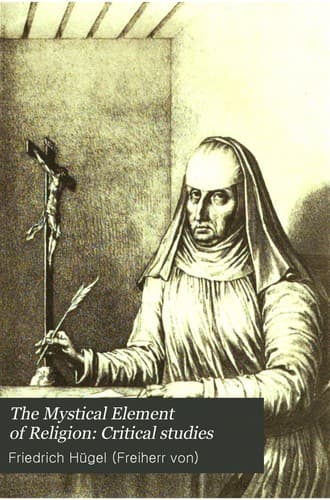
The Mystical Element of Religion, as studied in Saint Catherine of Genoa and her friends, Volume 2 (of 2)Hügel, Friedrich, Freiherr von
Religion
The Mystical Element of Religion, as studied in Saint Catherine of Genoa and her friends, Volume 2 (of 2)
Hügel, Friedrich, Freiherr von
Catherine, of Genoa, Saint, 1447-1510
(1) As to the circumstances of the time, it appears certain that it was
the ready circulation of the doctrines of the Spanish priest, Miguel de
Molinos in the _Guida Spirituale_, 1675, and the abuses of the kind we
have just now detailed, and that sprang from this circulation, which
formed the primary reason and motive for the otherwise excessively
severe treatment of a man and a book, which had both received the very
highest and the most deliberate ecclesiastical approbations. That these
two circumstances were the determining causes of at least the severity
of his condemnation is well brought out by the circumstance that,
during his two years’ trial (1685-1687), not only the short _Guida_ but
his whole obtainable correspondence (some twenty thousand letters) were
examined, and that it is at least as much on such occasional manuscript
material, and on Molinos’s own oral admissions,--in prison and
doubtless, in part at least, under torture,--that the condemnation was
based, containing, as it does, certain revoltingly immoral propositions
and confessions, admittedly absent from his published writings.
But if at least some shadow of doubt rests upon the moral character
of Molinos, not a shadow of such suspicion or of doubt concerning his
perfectly Catholic intentions can, in justice, be allowed to rest
upon his chief follower and the most distinguished apologist for his
doctrine, the saintly Oratorian and Bishop, the much-tried Cardinal
Petrucci; any more than Fénelon’s moral and spiritual character, or
deeply Catholic spirit and intentions, can, (in spite of the painfully
fierce and unjust attack upon both by Bossuet in his formally classic
invective, _Relation sur le Quiétisme_), for one moment be called
in question.[126] Other admittedly deeply spiritual and entirely
well-intentioned Catholics, whose writings were also condemned during
this time when devotional expressions having an at all quietistic tinge
or drift were very severely judged, are Mère Marie de l’Incarnation
(Marie Guyard), a French Ursuline Religious, who died in Canada in
1672, and the process of whose Beatification has been introduced; the
saintly French layman, Jean de Bernières-Louvigny, much admired by
Fénelon, who died in 1659; the very interior, though at times somewhat
fantastic, Secular Priest, Henri Marie Boudon, who died in 1702; and
the very austere but highly experienced ascetical writer, the Jesuit
Père Joseph Surin, whom Bossuet had formally approved, and who died in
1668.[127] But Madame Guyon herself, that much-tried and vehemently
opposed woman, was held, by many an undoubtedly Catholic-minded,
experienced and close observer, to be (in spite of the largely
misleading and indeed incorrect character of many of her analyses and
expressions) a truly saintly, entirely filial Catholic.[128]
Public-domain text, read in full here on John Shaqi.
Reviews
Reviews
No reviews yet
Be the first to share your thoughts on this work.
Elsewhere in the archive
Join the Discussion
Join the discussion
Sign in to leave a comment or review.
Sign InorCreate an account