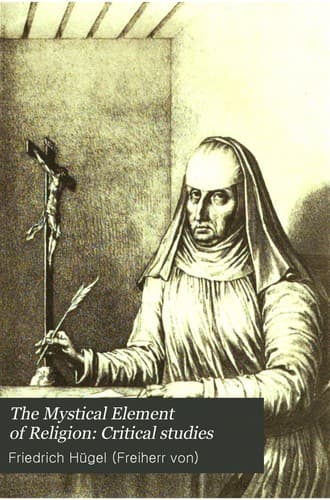
The Mystical Element of Religion, as studied in Saint Catherine of Genoa and her friends, Volume 2 (of 2)Hügel, Friedrich, Freiherr von
Religion
The Mystical Element of Religion, as studied in Saint Catherine of Genoa and her friends, Volume 2 (of 2)
Hügel, Friedrich, Freiherr von
Catherine, of Genoa, Saint, 1447-1510
(2) As to the limits of these condemnations, we must remember that only
two of them,--those of Molinos and of Fénelon,--claim to be directly
doctrinal at all; and that Fénelon was never really compromised in
the question of Quietism proper, but was condemned on questions of
Pure Love alone. Bossuet himself was far less sound as against the
central Quietist doctrine of the One Act, which, unless formally
revoked, lasts on throughout life, and hence need never be repeated;
Fénelon’s early criticism of the Molinos propositions remains one of
the clearest extant refutations of that error. Again in the matter of
the Passivity of advanced souls, Bossuet was distinctly less normal and
sober than Fénelon: for whilst Fénelon taught that in no state does
the soul lose all capacity, although the facility may greatly vary,
to produce distinct acts of the virtues or vocal prayers and other
partially external exercises, Bossuet taught that, in some cases, all
capacity of this kind is abolished.[129] “I take,” says Fénelon, “the
terms ‘Passive’ and ‘Passivity’ as they actually appear everywhere
in the language of the (sound) Mystics, as something opposed to the
terms ‘active’ and ‘activity’: ‘Passivity,’ taken in the sense of an
entire inaction of the will, would be a heresy.” And he then opposes
“Passivity,” not to “Action,” but to that “Activity,” which is a merely
natural, restless, and hurried excitation.[130]
(3) And as to the abiding significance of the whole anti-quietist
decisions and measures, we shall do well to consider the following
large facts. From St. Paul and St. John to Clement of Alexandria and
Origen; from these to Dionysius the Areopagite; from the Areopagite to
St. Bernard of Clairvaux and then the Franciscan and Dominican Mystics;
from these, again, on to the great Renaissance and Counter-Reformation
saints and writers of this type,--the German Cardinal Nicolas of Coes
and the Italian St. Catherine of Genoa, the Spaniards St. Teresa and
St. John of the Cross, and the French Saint Francis de Sales and
Saint Jane Frances de Chantal, we get a particular type of religious
experience and doctrine, which but unfolds and concentrates, with an
unusual articulation, breadth, and depth, what is to be found, on
some sides of their spiritual character and teaching, among Saints
and religious souls of the more mixed type, such as St. Augustine,
St. Anselm, St. Thomas of Aquin, and St. Ignatius Loyola. And this
mixed type, bearing within it a considerable amount of that mystical
quiet and emotional-speculative element, is again but a deepening, a
purification and a realization of one of the profoundest affinities and
constituents of every human heart and will.
Public-domain text, read in full here on John Shaqi.
Reviews
Reviews
No reviews yet
Be the first to share your thoughts on this work.
Elsewhere in the archive
Join the Discussion
Join the discussion
Sign in to leave a comment or review.
Sign InorCreate an account