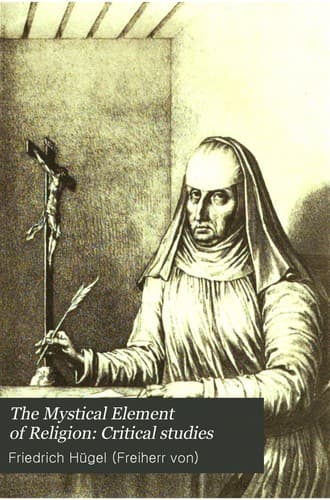
The Mystical Element of Religion, as studied in Saint Catherine of Genoa and her friends, Volume 2 (of 2)Hügel, Friedrich, Freiherr von
Religion
The Mystical Element of Religion, as studied in Saint Catherine of Genoa and her friends, Volume 2 (of 2)
Hügel, Friedrich, Freiherr von
Catherine, of Genoa, Saint, 1447-1510
Hence, even in the thickest of the quietist controversy, when that
mystical element must have seemed, to many, to be discredited once for
all, those best acquainted with the rich history of the Church, and
with the manifold requirements of the abiding religious consciousness,
could not and did not doubt that all that was good, deep, and true
in that element would continue to be upheld by, and represented in,
the Church.--And it is not difficult to point to the more or less
Mystical souls furnished by the Monks, the Friars; the Clerks-Regular,
specially the Jesuits; the Secular Clergy; and the Laity, down to
the present day. Such writers and Saints as Père de Caussade (_d._
about 1770) on the one hand, and Père Jean N. Grou (_d._ 1803) and
the Curé d’Ars (_d._ 1859) on the other hand, carry on the two
streams of the predominantly mystical and of the mixed type,--streams
so clearly observable before 1687 and 1699. Quietism, the doctrine
of the One Act; Passivity in a literal sense, as the absence or
imperfection of the power and use of initiative on the soul’s part in
any and every state: these doctrines were finally condemned, and most
rightly and necessarily condemned; the Prayer of Quiet, and various
states and degrees of an ever-increasing predominance of Action over
Activity,--an Action which is all the more the soul’s very own,
because the more occasioned, directed, and informed by God’s action
and stimulation,--these, and the other chief lines of the ancient
experience and practice, remain as true, correct, and necessary as ever.
5. _Rome’s alleged change of front._
And yet it is undeniable that the Roman events between 1675 and 1688 do
seem, at first sight, to justify the strongly Protestant Dr. Heppe’s
contention that those twelve years,--not to speak of the later troubles
of Madame Guyon and of Fénelon--witnessed a complete _volte face_, a
formal self-stultification, of the Roman teaching and authority, on
these difficult but immediately important matters.
(1) Let us put aside the many passages in Molinos’s _Guida_ which
were but (more or less) literal reproductions of the teachings
of such solemnly approved authorities as Saints Teresa, Peter of
Alcantara, John of the Cross, Francis de Sales and Jane Frances de
Chantal,--passages which, of course, remained uncondemned even in
Molinos’s pages, but which it would often be difficult to distinguish
from the parts of his book that were censured. Yet there still remain
such facts as the following.
Public-domain text, read in full here on John Shaqi.
Reviews
Reviews
No reviews yet
Be the first to share your thoughts on this work.
Elsewhere in the archive
Join the Discussion
Join the discussion
Sign in to leave a comment or review.
Sign InorCreate an account