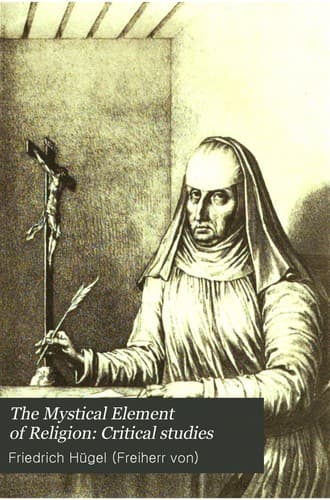
The Mystical Element of Religion, as studied in Saint Catherine of Genoa and her friends, Volume 2 (of 2)Hügel, Friedrich, Freiherr von
Religion
The Mystical Element of Religion, as studied in Saint Catherine of Genoa and her friends, Volume 2 (of 2)
Hügel, Friedrich, Freiherr von
Catherine, of Genoa, Saint, 1447-1510
Juan Falconi’s _Alfabeto_ and _Lettera_ were at their Fifth Italian
edition, 1680, and all five editions had been approved by the Master
of the Apostolic Palace; but only in 1688 were these writings
forbidden. Yet the _Lettera_ contains, with unsurpassed directness and
clearness, the central doctrine of Quietism: an exhortation to the
production of one single lively Act of Faith, which will then continue
uninterruptedly through the whole earthly life into eternity, and
which, consequently, is not to be repeated.[131]
Molinos’s _Guida_ and _Breve Trattato_ appeared in Rome, respectively
in 1675 and 1681, with the approbations of five theologians, four of
whom were Consultors of the Holy Office,--the Archbishop of Reggio;
the Minister-General of the Franciscans; the late General of the
Carmelites; Father Martin Esparza, the same Jesuit Theologian-Professor
of the Roman College who, some years before, had been one of those who
had examined and approved St. Catherine’s _Vita ed Opere_; and the
actual General of the Carmelites.[132]
Even after these two writings of Molinos had been criticised by the
Jesuits Bell Huomo and Segneri and the Clerk Regular Regio, (Segneri
enjoying a deservedly immense reputation, and showing in this affair
much moderation and a strong sense of the legitimate claims of
Mysticism), the Inquisition examined these criticisms, and forbade, not
the incriminated writings of Molinos and Petrucci, but the critique of
Bell Huomo _donec corrigatur_, and those of Regio and of Segneri (in
his _Lettera_ of 1681) absolutely. Segneri’s subsequent _Concordia_
almost cost him his life, so strong was the popular veneration of
Molinos.
Molinos indeed was the guest of Pope Innocent XI himself, and the
friend and confidant, amongst countless other spiritually-minded souls,
of various Cardinals, especially of the deeply devout Petrucci, Bishop
of Jesi, who was raised to the Cardinalate eighteen months after the
beginning of Molinos’s trial. The imprisonment of Molinos began in May
1685, but the trial did not end till August 1687, when (after nineteen
“Principal Errors of the New Contemplation” had been censured by the
Holy Office in February 1687) sixty-eight propositions, out of the
two hundred and sixty-three which had been urged against him, were
solemnly condemned: of these the clearly and directly immoral ones
being admittedly not derived from any printed book, or indeed any ever
published letter of his Molinos.[133]
Public-domain text, read in full here on John Shaqi.
Reviews
Reviews
No reviews yet
Be the first to share your thoughts on this work.
Elsewhere in the archive
Join the Discussion
Join the discussion
Sign in to leave a comment or review.
Sign InorCreate an account