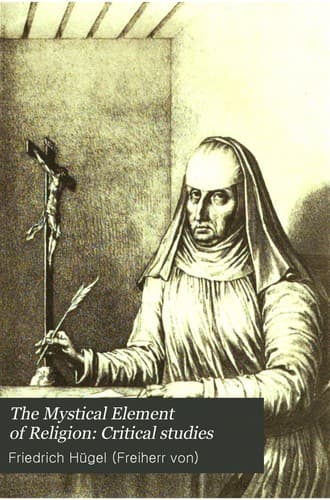
The Mystical Element of Religion, as studied in Saint Catherine of Genoa and her friends, Volume 2 (of 2)Hügel, Friedrich, Freiherr von
Religion
The Mystical Element of Religion, as studied in Saint Catherine of Genoa and her friends, Volume 2 (of 2)
Hügel, Friedrich, Freiherr von
Catherine, of Genoa, Saint, 1447-1510
(2) To estimate Rome’s attitude (as far as it concerns the ultimate
truth and completeness of these doctrines, taken in their most
characteristic and explicit forms) fairly, we shall have to put aside
all questions as to the motives that impelled, and the methods that
were employed, by either side against the other. Molinos may have been
even worse than the condemned propositions represent, and yet Petrucci
would remain a saintly soul; and we certainly are driven to ask with
Leibniz: “Si Molinos a caché du venin sous ce miel, est-il juste que
Petrucci et autres personnes de mérite en soient responsables?”[134]
But neither the wickedness of the one nor the sanctity of the other
would make the doctrines propounded by them, objectively, any less
solid or more spiritual than they are in themselves. The acutely
anti-Roman Anglican Bishop Burnet may not have invented or exaggerated
when he wrote from Rome, during those critical years, that one of the
chief motives which actuated the opponents of the Quietists was the
fact that, though the latter “were observed to become more strict in
their lives, more retired and serious in their mental devotions, yet …
they were not so assiduous at Mass, nor so earnest to procure Masses to
be said for their friends: nor … so frequently either at Confession or
in processions”: and so “the trade of those that live by these things
was sensibly sunk.”[135] And the cruel injustice of many details and
processes of the movement against the Quietists,--a movement which soon
had much of the character of a popular scare and panic, in reaction
against a previous, in part, heedless enthusiasm,--are beyond dispute
or justification. Yet mercenary and ruthless as part of the motives and
much of the action of the anti-quietists doubtlessly were, the question
as to the worth and wisdom of Quietism, (taken objectively, and not as
an excusable counter-excess but as a true synthesis of the spiritual
life), remains precisely where it was before.
(3) Now I think that two peculiarities, most difficult to notice at
the time, seriously differentiate the Molinist movement from the great
current of fully Catholic Mysticism, even in those points and elements
where the two are materially alike or even identical; and yet that
these peculiarities are but the caricature (through further emphasis
and systematization) of certain elements present, in a more latent
and sporadic manner, in the formulae and philosophic assumptions
or explanations of the older Mysticism,--elements which had been
borrowed too largely from a, at bottom, profoundly anti-incarnational
philosophy, not to be of far less value and of much greater danger than
the profoundly true experiences, nobly spiritual maxims, and exquisite
psychological descriptions which that predominantly Neo-Platonist
framework handed on.
Public-domain text, read in full here on John Shaqi.
Reviews
Reviews
No reviews yet
Be the first to share your thoughts on this work.
Elsewhere in the archive
Join the Discussion
Join the discussion
Sign in to leave a comment or review.
Sign InorCreate an account