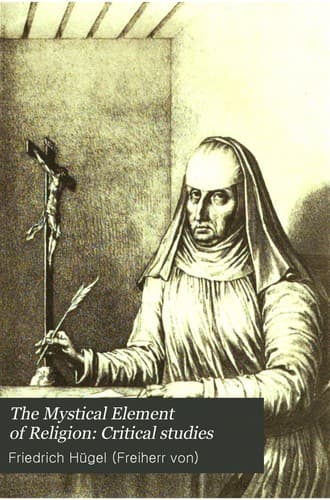
The Mystical Element of Religion, as studied in Saint Catherine of Genoa and her friends, Volume 2 (of 2)Hügel, Friedrich, Freiherr von
Religion
The Mystical Element of Religion, as studied in Saint Catherine of Genoa and her friends, Volume 2 (of 2)
Hügel, Friedrich, Freiherr von
Catherine, of Genoa, Saint, 1447-1510
The first peculiarity is that the older Mystics, especially those of
the type of St. Catherine of Genoa and St. John of the Cross, but
even also those of the more “mixed” type of Mysticism, such as St.
Teresa, had indeed quite freely used terms which are vividly true
as descriptions of the prima facie aspect and emotional impression
of certain states and experiences of the soul: “empty,” “fixed,”
“motionless,” “the reason and the will have ceased to act,” “doing
nothing,” “incapable of doing anything,” “moved by irresistible grace,”
“but one act,” “one single desire”: these and equivalent expressions
occur again and again. But these sayings do not here lead up to such a
deliberate and exclusive rule as is that given by Falconi, and repeated
by Molinos in his _Guida_, Nos. 103-106.[136]
This doctrine of the One Act, in this its negative form,--for it
is not to be repeated,--and in its application to the whole waking
and sleeping life, is first an exclusive concentration upon, and
then a wholesale extension of, one out of the several trends of the
older teaching, a doctrine which, compared with that teaching in its
completeness, is thin and doctrinaire, and as untrue to the full
psychological explanation and working requirements of the soul as it
is readily abusable in practice and contrary to the Incarnational type
of religion. It is impossible not to feel that the manifold great
ocean-waters of life, that the diversely blowing winds of God’s Spirit
are here, somehow, expected to flow and breathe in a little shortcut,
single channel, through a tiny pipe; one more infallible recipe or
prescription is here offered to us, hardly more adequate than the many
similar “sure” roads to salvation, declared by this or that body of
devout religionists to attach to the practice or possession of this or
that particular prayer or particular religious object.
And the second difference is that the older Catholic Mystics leave
less the impression that the external side of religion, its _body_,
is of little or no importance, and indeed very readily an obstacle to
its interior side, its _soul_. And this, again, for the simple reason
that their teaching is, in general, less systematic and pointed, more
incidental, and careless of much self-consistency.
Public-domain text, read in full here on John Shaqi.
Reviews
Reviews
No reviews yet
Be the first to share your thoughts on this work.
Elsewhere in the archive
Join the Discussion
Join the discussion
Sign in to leave a comment or review.
Sign InorCreate an account