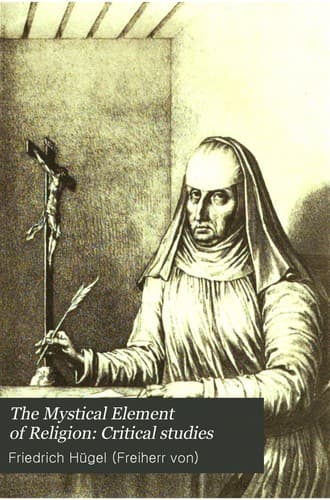
The Mystical Element of Religion, as studied in Saint Catherine of Genoa and her friends, Volume 2 (of 2)Hügel, Friedrich, Freiherr von
Religion
The Mystical Element of Religion, as studied in Saint Catherine of Genoa and her friends, Volume 2 (of 2)
Hügel, Friedrich, Freiherr von
Catherine, of Genoa, Saint, 1447-1510
Thus, after her greatest psycho-physical and spiritual experience
in November 1509, she declares to Vernazza, when he urges her to
let him write down the graces she has received from God, that “it
would, strictly speaking, be impossible to narrate those interior
things; whilst, of exterior ones, few or none have happened to
me.” And she never entirely loses her mental consciousness in any
state not recognized by herself as _maladif_. So, on a day of great
psycho-physical trouble in February or March 1510, “they thought she
must expire; but, though she lost both sight and speech, she never
lost her intelligence.” And even on September 11 and 12, amidst
foodlessness and suffocations, her intelligence still persists.--In
the March previous “her mind appeared to grow daily in contentment.”
Some days later, her attendants “saw how, after an hour of spasm and
breathlessness, and then a great restriction of all her being, she
returned to her normal condition, and addressed many beautiful words
to them.” And later on, “her attendants were amazed at seeing a body,
which seemed to be healthy, in such a tormented condition.” But “soon
after she laughed and spoke as one in health, and told them not to
distress themselves about her, since she was very contented; but that
they should see to it that they did much good, since the way of God is
very narrow.”[20]
3. _Interaction and mutual suggestion of her spiritual and physical
states._
As to the extraordinary closeness and readiness for mutual response
between her sensible impressions and her thoughts and emotions--her
sensations turning, all but automatically, into religious emotions,
and her thoughts and feelings translating themselves into appropriate
psycho-physical states--we have a mass of interesting evidence.
Thus when, about the end of November 1509, in response to her seeing,
on some wall of the Hospital, a picture of Our Lord at the Well of
Samaria, and to her asking Him for one drop of that Divine water,
“instantly a drop was given to her which refreshed her within and
without.” The spiritual idea and emotion is here accompanied and
further stimulated by the keenest psycho-physical impression of
drinking. And such an impression can even become painful through
its excessive suggestiveness. Thus she herself explains to Maestro
Boerio, on September 2, 1510, that she cannot long bear the sight
of his scarlet robe “because of what it suggests (represents) to my
memory,”--no doubt the fire of divine love. Three days later, on the
contrary, “she mentally saw herself lying upon a bier, surrounded by
many Religious robed in black,” and greatly rejoiced at the sight. Here
the very impression of black, the colour of death, will have conveyed,
during this special mood of hers, a downright psycho-physical pleasure,
somewhat as Boerio’s reappearance, on the former occasion, in a black
gown, had been a sensible relief to her.
Public-domain text, read in full here on John Shaqi.
Reviews
Reviews
No reviews yet
Be the first to share your thoughts on this work.
Join the Discussion
Join the discussion
Sign in to leave a comment or review.
Sign InorCreate an account