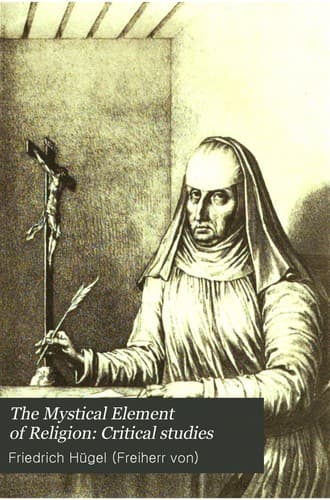
The Mystical Element of Religion, as studied in Saint Catherine of Genoa and her friends, Volume 2 (of 2)Hügel, Friedrich, Freiherr von
Religion
The Mystical Element of Religion, as studied in Saint Catherine of Genoa and her friends, Volume 2 (of 2)
Hügel, Friedrich, Freiherr von
Catherine, of Genoa, Saint, 1447-1510
So also with scents. When, certainly after 1499, “she perceived, on
the (right) hand of her Confessor, an odour which penetrated her very
heart,” and “which abode with her and restored both mind and body for
many days,” we have again a primarily mental act and state which she
herself knows well to be untransferable, even to Don Marabotto himself.
Here the association of ideas was, no doubt, the right hand of the
Priest and her daily reception, by means of it, of the Holy Eucharist.
For the latter, “the Bread from heaven, having within it all manner
of delight,” is already connected in her mind with an impression of
sweet odour. “One day, on receiving Communion, so much odour and
sweetness came to her, that she seemed to herself to be in Paradise.”
Probably the love for, and then the disgust at, the smell of wine, was
also connected with her Eucharistic experiences. Certainly “one day,
having received Holy Communion, she was granted so great a consolation
as to fall into an ecstasy, so that when the Priest wanted to give
her to drink from the Chalice (with unconsecrated wine) she had to be
brought back by force to her ordinary consciousness.” Vivid memories
of both sets of psycho-physical impressions are, I think, at work
when she says: “If a consecrated Host were to be given to me amongst
unconsecrated ones, I should be able to distinguish it by the very
taste, as I do wine from water.” And as the sight of red rapidly became
painful from the very excess of its mental suggestiveness, so will the
smell of wine have been both specially dear and specially painful to
her.[21]
Indeed her psycho-physical troubles possess, for the most part, a
still traceable, most delicate selectiveness as to date, range, form,
combination, and other peculiarities. Thus some of the most acute
attacks coincide, in their date of occurrence and general character, as
the biographers point out, with special saint’s and holy days: so in
the night leading into St. Lawrence’s day, August 9 and 10, 1510; so
on the Vigil of St. Bartholomew’s day, August 24; and so in the night
previous to and on the Feast (August 28) of St. Augustine, special
Patron of her only sister’s Order and of the Convent in which her own
Conversion had taken place thirty-seven years before. Yet we have also
seen how that these synchronisms did not rise to the heights which
were soon desired by her biographers, for we know that she died, not
(as they would have it) on the Feast of the Exaltation of the Cross,
September 14, but early on the day following.
Public-domain text, read in full here on John Shaqi.
Reviews
Reviews
No reviews yet
Be the first to share your thoughts on this work.
Join the Discussion
Join the discussion
Sign in to leave a comment or review.
Sign InorCreate an account