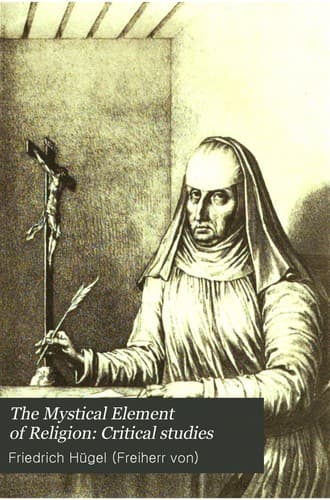
The Mystical Element of Religion, as studied in Saint Catherine of Genoa and her friends, Volume 2 (of 2)Hügel, Friedrich, Freiherr von
Religion
The Mystical Element of Religion, as studied in Saint Catherine of Genoa and her friends, Volume 2 (of 2)
Hügel, Friedrich, Freiherr von
Catherine, of Genoa, Saint, 1447-1510
more sensitive to the divine impressions.”[179]
Thus we get an impressive, simple and yet varied, conception of
spirituality, in which a real continuity, and a power and obligation of
mutual understanding and aid underlies all the changes of degree and
form, from first to last. For from first to last there are different
degrees, but of the same supernatural grace acting in and upon the same
human nature responsive in different degrees and ways. From first to
last there is, necessarily and at every step, the Supernatural: at no
point is there any necessary presence of, or essential connection with,
the Miraculous or the Abnormal.
4. _Spinoza, Leibniz, Kant._
Theology and Philosophy have not ceased to occupy themselves, at least
indirectly, with the substance of these great questions, since they
furnished the subject-matter to Bossuet and Fénelon in their memorable
controversy; somewhat over-subtle although some of it was in its
earlier phases, owing to Fénelon’s chivalrous anxiety to defend, as far
as possible, the very expressions, often so nebulous and shifting, of
his cousin, Madame Guyon.
(1) Indeed about twenty years before that controversy, Spinoza had,
in his _Theologico-Political Treatise_, and then, more impressively
still, in his _Ethics_, made a brilliant assault upon all, especially
all religious, self-seeking. Also on this point these writings showed
that strange, pathetic combination of grandly religious intuitions
and instincts with a Naturalistic system which, logically, leaves no
room for those deepest requirements of that great soul; and here they
revealed, in addition, considerable injustice towards the, doubtless
very mixed and imperfect, motives of average humanity.
True intuition speaks in his _Treatise_ (published in 1670) in the
words: “Since the love of God is man’s supreme beatitude and the final
end and scope of all human actions: it follows that only that man
conforms to the divine law, who strives to love God, not from fear of
punishment, nor from the love of some other thing, such as delights,
fame, and so forth, but from this motive alone, that he knows God, or
that he knows the knowledge and love of God, to be his supreme end.”
But a little further back we learn that “the more we know the things
of Nature, the greater and the more perfect knowledge of God do we
acquire”; a frank application of the pure Pantheism of his reasoned
system.
Public-domain text, read in full here on John Shaqi.
Reviews
Reviews
No reviews yet
Be the first to share your thoughts on this work.
Elsewhere in the archive
Join the Discussion
Join the discussion
Sign in to leave a comment or review.
Sign InorCreate an account