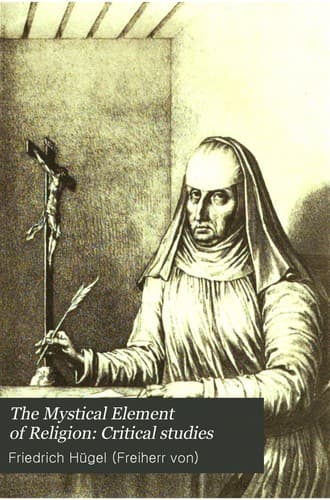
The Mystical Element of Religion, as studied in Saint Catherine of Genoa and her friends, Volume 2 (of 2)Hügel, Friedrich, Freiherr von
Religion
The Mystical Element of Religion, as studied in Saint Catherine of Genoa and her friends, Volume 2 (of 2)
Hügel, Friedrich, Freiherr von
Catherine, of Genoa, Saint, 1447-1510
In his _Ethics_, again, a noble intuition finds voice where he says:
“Even if we did not know our Mind,” our individual soul, “to be
eternal, we should still put Piety and Religion and, in a word, all
those virtues that are to be referred to magnanimity and generosity,
first in our esteem.” But he is doubtless excessive in his picturing of
the downright, systematic immorality of attitude of ordinary men--the
“slaves” and “mercenaries.” “Unless this hope of laying aside the
burdens of Piety and Religion after death and of receiving the price
of their service, and this fear of being punished by dire punishments
after death were in men, and if they, contrariwise, believed that
their minds would perish with their bodies: they would let themselves
go to their natural inclination and would decide to rule all their
actions according to their lust.” And he is doubtlessly, though nobly,
excessive in his contrary ideal: “He who loves God cannot strive that
God shall love him in return,”--an ideal which is, however, certainly
in part determined by his philosophy, which knows no ultimate abiding
personality or consciousness either in God or man.
Yet, once again, we have him at his inspiring best when,
Catherine-like, he tells us: “The supreme Good of those who pursue
virtue is common to them all, and all are equally able to rejoice in
it”; and “this love towards God is incapable of being stained by the
passions of envy and bitterness, but is increased in proportion as we
figure to ourselves a larger number of men joined to God by the same
bonds of love”; when he declares: “we do not enjoy beatitude because we
master our passions; rather, contrariwise, do we master our passions
because we enjoy beatitude”; and when he insists, with no doubt too
indiscriminating, too Jacopone-like, a simplification, upon what,
in its substance, is a profound truth: “the intellectual,” the pure
“love of the soul for God is the very love of God, wherewith God loves
Himself.”[180]
(2) It was, however, the astonishingly circumspect and many-sided
Leibniz who, indefinitely smaller soul though he was, succeeded,
perhaps better than any other modern philosopher, in successfully
combining the divers constitutive elements of the act and state of
Pure Love, when he wrote in 1714: “Since true Pure Love consists in a
state of soul which makes me find pleasure in the perfections and the
felicity of the object loved by me, this love cannot but give us the
greatest pleasure of which we are capable, when God is that object.
And, though this love be disinterested, it already constitutes, even
thus simply by itself, our greatest-good and deepest interest.”
Public-domain text, read in full here on John Shaqi.
Reviews
Reviews
No reviews yet
Be the first to share your thoughts on this work.
Elsewhere in the archive
Join the Discussion
Join the discussion
Sign in to leave a comment or review.
Sign InorCreate an account