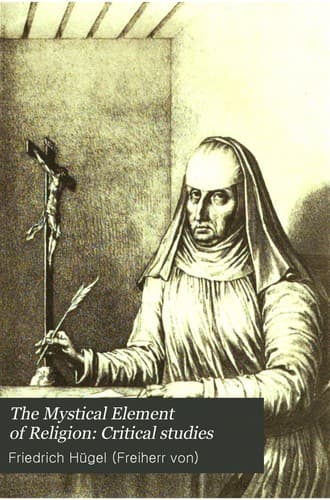
The Mystical Element of Religion, as studied in Saint Catherine of Genoa and her friends, Volume 2 (of 2)Hügel, Friedrich, Freiherr von
Religion
The Mystical Element of Religion, as studied in Saint Catherine of Genoa and her friends, Volume 2 (of 2)
Hügel, Friedrich, Freiherr von
Catherine, of Genoa, Saint, 1447-1510
Or, as he wrote in 1698: “Our love of others cannot be separated
from our true good, nor our love of God from our felicity. But it is
equally certain that the consideration of our own particular good, as
distinguished from the pleasure which we taste in seeing the felicity
of another, does not enter into Pure Love.” And earlier still he
had defined the act of loving as “the finding one’s pleasure in the
felicity of another”; and had concluded thence that Love is for man
essentially an enjoyment, although the specific motive of love is not
the pleasure or the particular good of him who loves, but the good or
the felicity of the beloved object.[181]
(3) Yet it is especially Kant who, with his predominant hostility to
all Eudaemonism in Morality and Religion, has, more than all others,
renewed the controversy as to the relations between virtue and piety
on the one hand, and self-seeking motives on the other, and who is
popularly credited with an entirely self-consistent antagonism to even
such a wise and necessary attitude as are the amended positions of
Fénelon and those of Leibniz. And yet I sincerely doubt whether (if
we put aside the question as to the strictly logical consequences of
his Critical Idealism, such as that Idealism appears in its greatest
purity in the _Critique of Pure Reason_, 1781; and if we neglect the
numerous, often grossly unjust, Spinoza-like sallies against the
supposed undiluted mercenariness of ordinary piety, which abound in his
_Religion within the Limits of Pure Reason_, 1793), we could readily
find any explicit pronouncement hopelessly antagonistic to the Catholic
Pure-Love doctrine.
Public-domain text, read in full here on John Shaqi.
Reviews
Reviews
No reviews yet
Be the first to share your thoughts on this work.
Elsewhere in the archive
Join the Discussion
Join the discussion
Sign in to leave a comment or review.
Sign InorCreate an account