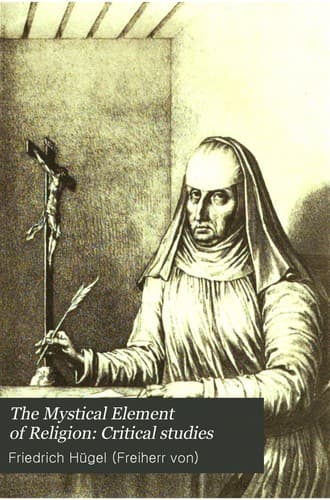
The Mystical Element of Religion, as studied in Saint Catherine of Genoa and her friends, Volume 2 (of 2)Hügel, Friedrich, Freiherr von
Religion
The Mystical Element of Religion, as studied in Saint Catherine of Genoa and her friends, Volume 2 (of 2)
Hügel, Friedrich, Freiherr von
Catherine, of Genoa, Saint, 1447-1510
For the survival after the body’s death, indubitably attributed to
the Psyche in the Homeric Poems, is conceived there, throughout,
as a miserably shrunken consciousness, and one which is dependent
for its continuance upon the good offices bestowed by the survivors
upon the corpse and grave. And the translation of the still living
Menelaus to Elysium (Od. IV, 560-568) is probably a later insertion;
belongs to a small class of exceptional cases; implies the writer’s
inability to conceive a heightened consciousness for the soul, after
the soul’s separation from the body; and is based, not upon any virtue
or reward, but upon Menelaus’s family-relationship to Zeus. Ganymede
gets similarly translated because of his physical beauty (II. XX, 232
_seq._).
Hesiod, though later than Homer as a writer, gives us, in his account
of the Five Ages of the World (_Works and Days_, ll. 109-201), some
traces of an Animistic conception of a heightened life of the bodiless
soul beyond the grave,--a conception which had been neglected or
suppressed by Homer, but which had evidently been preserved alive in
the popular religion of, at least, Central Greece. Yet Hesiod knows of
such a life only for the Golden and for the Silver Ages, and for some
miraculous, exceptional cases of the fourth, the Heroic Age: already
in the third, the Bronze Age, and still more emphatically in his own
fifth, the Iron Age, there are no such consolations: nothing but the
shrunken consciousness of the Homeric after-death Psyche is, quite
evidently, felt by him to be the lot of all souls in the hard, iron
present.
The Cultus of the Heroes is already registered in Draco’s Athenian
Laws, in about 620 B.C., as a traditional custom. And these Heroes have
certainly lived at one time as men upon earth, and have become heroes
only after death; their souls, though severed from the body, live a
heightened imperishable life, indeed one that can mightily help men
here below and now,--so at Delphi and at Salamis against the Persians.
Yet here again each case of such an elevation was felt to be a miracle,
an exception incapable of becoming a universal law: not even the germ
of a belief in the Immortality of the soul as such seems to be here.
Public-domain text, read in full here on John Shaqi.
Reviews
Reviews
No reviews yet
Be the first to share your thoughts on this work.
Elsewhere in the archive
Join the Discussion
Join the discussion
Sign in to leave a comment or review.
Sign InorCreate an account