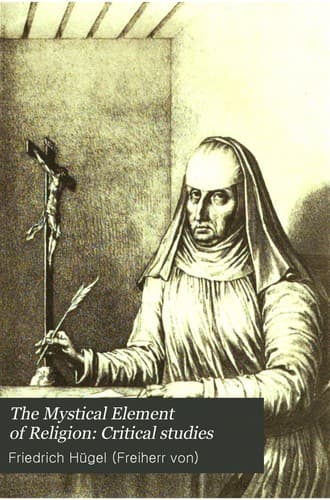
The Mystical Element of Religion, as studied in Saint Catherine of Genoa and her friends, Volume 2 (of 2)Hügel, Friedrich, Freiherr von
Religion
The Mystical Element of Religion, as studied in Saint Catherine of Genoa and her friends, Volume 2 (of 2)
Hügel, Friedrich, Freiherr von
Catherine, of Genoa, Saint, 1447-1510
Again, the common Church-teaching is undoubtedly voiced by St. Thomas
in the words, “Since these souls are completely averse to the final end
of right reason, they must be declared to be without any good will.”
Yet St. Thomas himself (partly in explanation of the Areopagite’s
words, “the evil spirits desire the good and the best, namely, to
be, to live, and to understand”), is obliged to distinguish between
such souls’ deliberate will and their “natural will and inclination,”
and to proclaim that this latter, “which is not from themselves but
from the Author of nature, who put this inclination into nature … can
indeed be good.”[237] And, if we would not construct a scheme flatly
contradictory of all earthly experience, we can hardly restrict the
soul, even in the beyond, to entirely indeliberate, good inclinations,
and to fully deliberate, bad volitions, but cannot help interposing
an indefinite variety of inchoative energizings, half-wishes, and
the like, and thinking of these as mixed with good and evil. Indeed
this conclusion seems also required by the common teaching that the
suffering there differs from soul to soul, and this because of the
different degrees of the guilt: for such degrees depend undoubtedly
even more upon the degree of deliberation and massiveness of the will
than upon the degree of objective badness in the deed, and hence can
hardly fail to leave variously small or large fragments of more or less
good and imperfectly deliberate wishings and energizings present in the
soul.
And finally Catherine’s “little drop of Love” would, she says, “at
once” turn Hell into Heaven, and hence cannot mean some ordinary good
moral disposition or even such supernatural virtues as theological
Faith and Hope, but Pure Love alone, which latter queen of all the
virtues she is explicitly discussing there. Thus she in nowise requires
the absence from these souls of a certain remnant of semi-deliberate
virtue of a less exalted, and not necessarily regenerative kind.
3. _Mitigation of the sufferings of the lost._
Public-domain text, read in full here on John Shaqi.
Reviews
Reviews
No reviews yet
Be the first to share your thoughts on this work.
Elsewhere in the archive
Join the Discussion
Join the discussion
Sign in to leave a comment or review.
Sign InorCreate an account