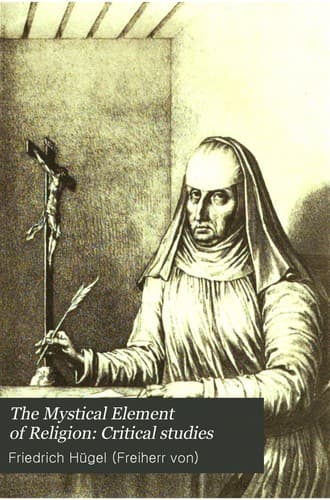
The Mystical Element of Religion, as studied in Saint Catherine of Genoa and her friends, Volume 2 (of 2)Hügel, Friedrich, Freiherr von
Religion
The Mystical Element of Religion, as studied in Saint Catherine of Genoa and her friends, Volume 2 (of 2)
Hügel, Friedrich, Freiherr von
Catherine, of Genoa, Saint, 1447-1510
As to the Mitigation of the Suffering, it is remarkable that Catherine,
who has been so bold concerning the source of the pains, and the
dispositions, of the lost souls, does not more explicitly teach such
an alleviation. I say “remarkable,” because important Fathers and
Churches, that were quite uninfected by Origenism, have held and have
acted upon such a doctrine. St. Augustine, in his _Enchiridion_ (A.D.
423 (?)) tells us that “in so far as” the Offering of the Sacrifice of
the Altar and Alms “profit” souls in the beyond, “they profit them by
procuring a full remission (of the punishment), or at least that their
damnation may become more tolerable.” And after warning men against
believing in an end to the sufferings of the lost, he adds: “But let
them consider, if they like, that the sufferings of the damned are
somewhat mitigated during certain intervals of time.”[238]--Saints
John Chrysostom and John Damascene, thoroughly orthodox Greek Fathers,
and the deeply devout hymn-writer Prudentius among the Latins, teach
similar doctrine; and in many ancient Latin missals, ranging from the
eleventh to the fourteenth century, prayers for the Mitigation of the
Sufferings of the Damned are to be found.[239]
Hence the great Jesuit Theologian Petau, though not himself
sharing this view, can declare: “Concerning such a breathing-time
(_respiratio_) of lost souls, nothing certain has as yet been decreed
by the Catholic Church, so that this opinion of most holy Fathers
should not temerariously be rejected as absurd, even though it be
foreign to the common opinion of Catholics in our time.”[240] And the
Abbé Emery, that great Catholic Christian, the second founder of St.
Sulpice, who died in 1811, showed, in a treatise _On the Mitigation
of the Pains of the Damned_, that this view had also been held by
certain Scholastic Theologians, and had been defended, without any
opposition, by Mark of Ephesus, in the Sessions of the Council of
Florence (A.D. 1439); and concluded that this doctrine was not contrary
to the Catholic Faith and did not deserve any censure. The most learned
Theologians in Rome found nothing reprehensible in this treatise, and
Pope Pius VII caused his Theologian, the Barnabite General, Padre
Fontana, to thank M. Emery for the copy sent by him to the Holy
Father.[241]
Public-domain text, read in full here on John Shaqi.
Reviews
Reviews
No reviews yet
Be the first to share your thoughts on this work.
Elsewhere in the archive
Join the Discussion
Join the discussion
Sign in to leave a comment or review.
Sign InorCreate an account