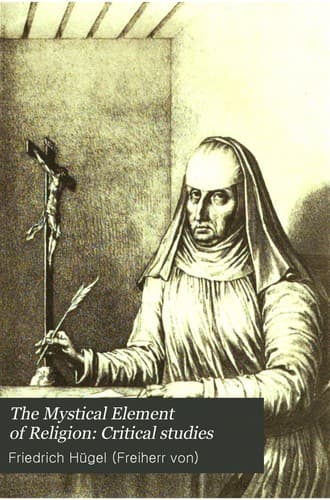
The Mystical Element of Religion, as studied in Saint Catherine of Genoa and her friends, Volume 2 (of 2)Hügel, Friedrich, Freiherr von
Religion
The Mystical Element of Religion, as studied in Saint Catherine of Genoa and her friends, Volume 2 (of 2)
Hügel, Friedrich, Freiherr von
Catherine, of Genoa, Saint, 1447-1510
Catherine herself cannot well have been thinking of anything but some
such Mitigation when she so emphatically teaches that God’s mercy
extends even into Hell. Indeed, even the continuation of this great
saying in the present _Vita_-text formally teaches such Mitigation, yet
practically withdraws it, by making it consist in a rebate and change,
from an infinitude in degree and duration into a finitude in degree
though not in duration.[242] But, as we have already found, this highly
schematic statement is doubtless one of the later glosses, in which
case her true meaning must have been substantially that of the Fathers
referred to, viz. that the suffering, taken as anyhow finite in its
degree, gets mercifully mitigated for these souls.--And, if she was
here also faithful to her general principles, she will have conceived
the mitigation, not as simply sporadic and arbitrary, but as more or
less progressive, and connected with the presence in these souls of
those various degrees of semi-voluntary good inclinations and wishes,
required by her other saying. Even if these wishings could slowly and
slightly increase, and the sufferings could similarly decrease, this
would in nowise imply or require a final full rectification of the
deliberate will itself, and hence not a complete extinction of the
resultant suffering. Hell would still remain essentially distinct
from Purgatory; for in Purgatory the deliberate, active will is good
from the first, and only the various semi-volitions and old habits are
imperfect, but are being gradually brought into full harmony with that
will, by the now complete willing of the soul; and hence this state
has an end; whereas in Hell the deliberate, active will is bad from
the first, and only various partially deliberate wishes and tendencies
are good, but cannot be brought to fruition in a full virtuous
determination of the dominant character of the soul, and hence _this_
state has no end.
4. _The Endlessness of Hell._
And lastly, as to the Endlessness of this condition of the Lost, it is,
of course, plain that Catherine held this defined doctrine; and again,
that “the chief weight, in the Church-teaching as to Hell, rests upon
Hell’s Eternity.”[243]
Here I would suggest five groups of considerations:
Public-domain text, read in full here on John Shaqi.
Reviews
Reviews
No reviews yet
Be the first to share your thoughts on this work.
Elsewhere in the archive
Join the Discussion
Join the discussion
Sign in to leave a comment or review.
Sign InorCreate an account