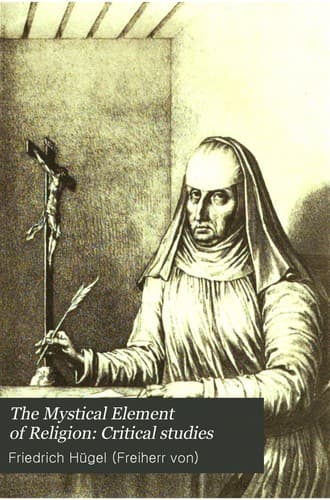
The Mystical Element of Religion, as studied in Saint Catherine of Genoa and her friends, Volume 2 (of 2)Hügel, Friedrich, Freiherr von
Religion
The Mystical Element of Religion, as studied in Saint Catherine of Genoa and her friends, Volume 2 (of 2)
Hügel, Friedrich, Freiherr von
Catherine, of Genoa, Saint, 1447-1510
(1) Precisely this Eternity appears to be the feature of all others
which is ever increasingly decried by contemporary philosophy and
liberal theology as impossible and revolting. Thus it is frequently
argued as though, not the indiscriminateness nor the materiality nor
the forensic externality nor the complete fixity of the sufferings, nor
again the complete malignity of the lost were incredible, and hence
the unendingness of such conditions were impossible of acceptance;
but, on the contrary, as though,--be the degree and nature of those
sufferings conceived as ever so discriminated, spiritual, interior, and
relatively mobile, and as occasioned and accompanied by a disposition
in which semi-voluntary good is present,--the simple assumption of
anything unending or final about them, at once renders the whole
doctrine impossible to believe. It is true that Tennyson and Browning
take the doctrine simply in its popular Calvinistic form, and then
reject it; and even John Stuart Mill and Frederick Denison Maurice
hardly consider the eternity separately. But certainly that thoughtful
and religious-minded writer, Mr. W. R. Greg, brings forward the
eternity-doctrine as, already in itself, “a _curiosa infelicitas_ which
is almost stupidity on the part of the Church.”[244]
(2) Yet it is plain how strongly, even in Mr. Greg’s case, the supposed
(local, physical, indiscriminate, etc.) nature of the state affects
the writer’s judgment as to the possibility of its unendingness,--as
indeed is inevitable. And it is even clearer, I think, that precisely
this eternity-doctrine stands for a truth which is but an ever-present
mysterious corollary to every deeply ethical or spiritual, and,
above all, every specifically Christian view of life. For every such
view comes, surely, into hopeless collision with its own inalienable
requirements if it _will_ hold that the deepest ethical and spiritual
acts and conditions are,--avowedly performed though they be in time
and space--simply temporary in their inmost nature and effects;
whereas every vigorously ethical religion, in so far as it has reached
a definite personal-immortality doctrine at all, cannot admit that
the soul’s deliberate character remains without any strictly final
and permanent results. The fact is that we get here to a profound
ethical and spiritual postulate, which cannot be adequately set aside
on the ground that it is the product of barbarous ages and vindictive
minds, since this objection applies only to the physical picturings,
the indiscriminateness, non-mitigation, and utter reprobation; or on
the ground that a long, keen purification, hence a temporally finite
suffering, would do as well, since, when all this has completely
passed away, there would be an entire obliteration of all difference
in the consequences of right and wrong; or that acts and dispositions
built up in time cannot have other than finite consequences, since
Public-domain text, read in full here on John Shaqi.
Reviews
Reviews
No reviews yet
Be the first to share your thoughts on this work.
Elsewhere in the archive
Join the Discussion
Join the discussion
Sign in to leave a comment or review.
Sign InorCreate an account