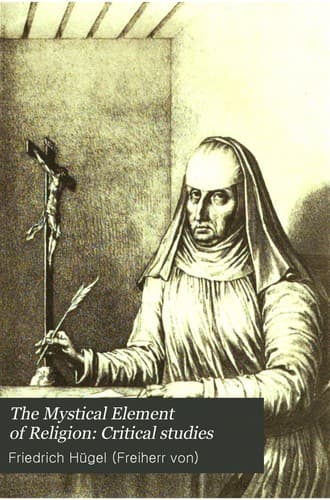
The Mystical Element of Religion, as studied in Saint Catherine of Genoa and her friends, Volume 2 (of 2)Hügel, Friedrich, Freiherr von
Religion
The Mystical Element of Religion, as studied in Saint Catherine of Genoa and her friends, Volume 2 (of 2)
Hügel, Friedrich, Freiherr von
Catherine, of Genoa, Saint, 1447-1510
this is to naturalize radically the deepest things of life; or finally
that “Evil,” as the Areopagite would have it, “is not,”[245] since
thus the very existence of the conviction as to free-will and sin
becomes more inexplicable than the theoretical difficulties against
Libertarianism are insoluble.--Against this deep requirement of the
most alert and complete ethical and spiritual life the wave of any
Apocatastasis-doctrine or -emotion will, in the long run, ever break
itself in vain.
(3) The doctrine of Conditional Immortality has, I think, many
undeniable advantages over every kind of Origenism. This view does not,
as is often imputed to it, believe in the annihilation by Omnipotence
of the naturally immortal souls of impenitent grave sinners; but simply
holds that human souls begin with the capacity of acquiring, with the
help of God’s Spirit, a spiritual personality, built up out of the mere
possibilities and partial tendencies of their highly mixed natures,
which, if left uncultivated and untranscended, become definitely fixed
at the first, phenomenal, merely individual level,--so that spiritual
personality alone deserves to live on and does so, whilst this animal
individuality does not deserve and does not do so. The soul is thus
not simply born as, but can become more and more, that “inner man” who
alone persists, indeed who “is renewed day by day, even though our
outward man perish.”[246]
This conception thus fully retains, indeed increases, the profound
ultimate difference between the results of spiritual and personal, and
of animal and simply individual life respectively,--standing, as it
does, at the antipodes to Origenism; it eliminates all unmoralized,
unspiritualized elements from the ultimate world, without keeping souls
in an apparently fruitless suffering; and it gives full emphasis to a
supremely important, though continually forgotten fact,--the profoundly
expensive, creative, positive process and nature of spiritual
character. No wonder, then, that great thinkers and scholars, such
as Goethe, Richard Rothe, Heinrich Holtzmann, and some Frenchmen and
Englishmen have held this view.[247]
Yet the objections against this view, taken in its strictness, are
surely conclusive. For how can an originally simply mortal substance,
force, or entity become immortal, and a phenomenal nature be leavened
by a spiritual principle which, _ex hypothesi_, is not present within
it? And how misleadingly hyperbolical, according to this, would be
the greatest spiritual exhortations, beginning with those of Our Lord
Himself!
Public-domain text, read in full here on John Shaqi.
Reviews
Reviews
No reviews yet
Be the first to share your thoughts on this work.
Elsewhere in the archive
Join the Discussion
Join the discussion
Sign in to leave a comment or review.
Sign InorCreate an account