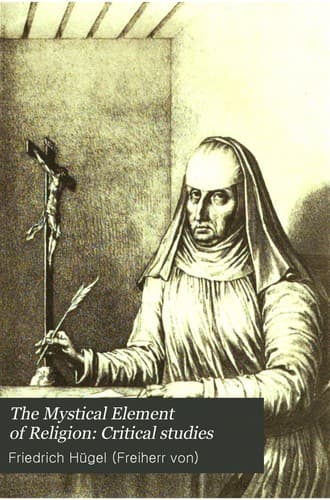
The Mystical Element of Religion, as studied in Saint Catherine of Genoa and her friends, Volume 2 (of 2)Hügel, Friedrich, Freiherr von
Religion
The Mystical Element of Religion, as studied in Saint Catherine of Genoa and her friends, Volume 2 (of 2)
Hügel, Friedrich, Freiherr von
Catherine, of Genoa, Saint, 1447-1510
(4) And yet the conception of Conditional Immortality cannot be
far from the truth, since everything, surely, points to a lowered
consciousness in the souls in question, or at least to one lower
than that in the ultimate state of the saved. This conception of the
shrunken condition of these souls was certainly held by Catherine,
even if the other, the view of a heightened, consciousness, appears
in hortatory passages which just _may_ be authentic; and indeed only
that conception is conformable with her fundamental position that
love alone is fully positive and alone gives vital strength, and that
all fully deliberate love is absent from the lost souls. And if we
consider how predominantly hortatory in tone and object the ordinary
teaching on this point cannot fail to be; and, on the other hand, how
close to Manichaeism, any serious equating of the force and intensity
of life and consciousness between the Saved and the Lost would be, we
can hardly fail to find ourselves free, indeed compelled, to hold a
lesser consciousness for the Lost than for the Saved. Whilst the joyful
life of the Saved would range, in harmonious intensity, beyond all that
we can experience here, the painful consciousness of the Lost would
be, in various degrees, indefinitely less. The Saved would thus not be
only _other_ than the Lost, they would actually be _more_: for God is
Life supreme, and, where there is more affinity with God, there is more
life, and more consciousness.
(5) But, if the view just stated is the more likely one, then we
cannot soften the sufferings of those souls, by giving them a sense of
Eternity, of one unending momentary Now, instead of our earthly sense
of Succession, as Cardinal Newman and Father Tyrrell have attempted to
do, in a very instructive and obviously orthodox manner.[248] I shall
presently argue strongly in favour of some consciousness of Eternity
being traceable in our best moments here, and of this consciousness
being doubtless more extended in the future blessed life. But here I
have only to consider whether for one who, like Catherine, follows the
analogy of earthly experience, the Lost should be considered nearer to,
or farther from, such a _Totum-Simul_ consciousness than we possess
now, here below, at our best? And to this the answer must, surely, be
that they are further away from it. Yet God in His mercy may allow
this greater successiveness, if unaccompanied by any keen memory or
prevision, to help in effecting that mitigation of the suffering which
we have already allowed.
IV. CATHERINE AND PURGATORY.
1. _Introductory._
(1) _Changed feeling concerning Purgatory._
Public-domain text, read in full here on John Shaqi.
Reviews
Reviews
No reviews yet
Be the first to share your thoughts on this work.
Elsewhere in the archive
Join the Discussion
Join the discussion
Sign in to leave a comment or review.
Sign InorCreate an account