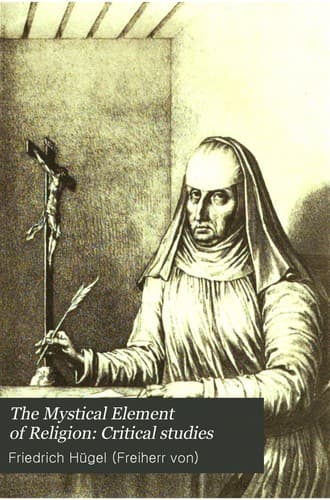
The Mystical Element of Religion, as studied in Saint Catherine of Genoa and her friends, Volume 2 (of 2)Hügel, Friedrich, Freiherr von
Religion
The Mystical Element of Religion, as studied in Saint Catherine of Genoa and her friends, Volume 2 (of 2)
Hügel, Friedrich, Freiherr von
Catherine, of Genoa, Saint, 1447-1510
In the matter of a Purgatory, a very striking return of religious
feeling towards its normal equilibrium has been occurring in the most
unexpected, entirely unprejudiced quarters, within the last century
and a half. In Germany we have Lessing, who, in the wake of Leibniz,
encourages the acceptance of “that middle state which the greater part
of our fellow-Christians have adopted”: Schleiermacher, who calls the
overpassing of a middle state by a violent leap at death “a magical
proceeding”; David F. Strauss, who entirely agrees; Carl von Hase, who,
in his very Manual of Anti-Roman Polemics admits that “most men when
they die are probably too good for Hell, but they are certainly too bad
for Heaven”; the delicately thoughtful philosopher Fechner who, in the
most sober-minded of his religious works, insists upon our “conceiving
the life beyond according to the analogy of this-life conditions,” and
refers wistfully to “the belief which is found amongst all peoples
and is quite shrunken only among Protestants--that the living can
still do something to aid the dead”; and Prof. Anrich, probably the
greatest contemporary authority on the Hellenic elements incorporated
in Christian doctrine, declares, all definite Protestant though he
is, that “legitimate religious postulates underlie the doctrine of
Purgatory.”[249] And in England that sensitively religious Unitarian,
W. R. Greg, tells us “Purgatory, ranging from a single day to a century
of ages, offers that borderland of discriminating retribution for which
justice and humanity cry out”; and the Positivist, John Stuart Mill,
declares at the end of his life: “All the probabilities in case of a
future life are that such as we have been made or have made ourselves
before the change, such we shall enter into the life hereafter.… To
imagine that a miracle will be wrought at death … making perfect every
one whom it is His will to include among His elect … is utterly opposed
to every presumption that can be adduced from the light of nature.”[250]
(2) _Causes of the previous prejudice._
Public-domain text, read in full here on John Shaqi.
Reviews
Reviews
No reviews yet
Be the first to share your thoughts on this work.
Elsewhere in the archive
Join the Discussion
Join the discussion
Sign in to leave a comment or review.
Sign InorCreate an account