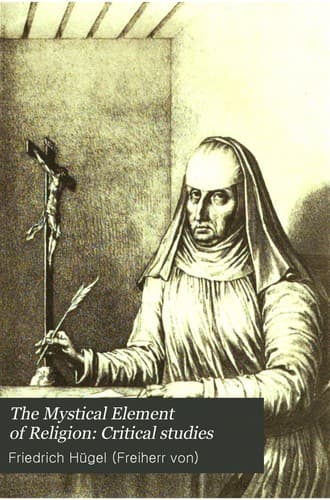
The Mystical Element of Religion, as studied in Saint Catherine of Genoa and her friends, Volume 2 (of 2)Hügel, Friedrich, Freiherr von
Religion
The Mystical Element of Religion, as studied in Saint Catherine of Genoa and her friends, Volume 2 (of 2)
Hügel, Friedrich, Freiherr von
Catherine, of Genoa, Saint, 1447-1510
As we have already repeatedly seen in less final matters, so here once
more, at the end, we can trace the sad impoverishment to the spiritual
outlook produced by the esteem in which the antique world generally
held the psycho-physical peculiarities of trances, as directly
valuable or even as prophetic of the soul’s ultimate condition; the
contraposition and exaltation, already on the part of Plato and
Aristotle, of a supposed non-actively contemplative, above a supposed
non-contemplatively active life; the largely excessive, not fully
Christianizable, doctrines of the Neo-Platonists as to the Negative,
Abstractive way, when taken as self-sufficient, and as to Quiet,
Passivity, and Emptiness of Soul, when understood literally; and the
conception, rarely far away from the ancient thinkers, of the soul as a
substance which, full-grown, fixed and stainless at the first, requires
but to be kept free from stain up to the end.
And yet the diminution of vitality in the trance, and even the
inattention to more than one thing at a time in Contemplation, are,
in themselves, defects, at best the price paid for certain gains; the
active and the contemplative life are, ultimately, but two mutually
complementary sides of life, so that no life ever quite succeeds in
eliminating either element, and life, _caeteris paribus_, is complete
and perfect, in proportion as it embraces both elements, each at
its fullest, and the two in a perfect interaction; the Negative,
Abstractive way peremptorily requires also the other, the Affirmative,
Concrete way; the Quiet, Passivity, Emptiness are really, when
wholesome, an incubation for, or a rest from, Action, indeed they are
themselves a profound action and peace, and the soul is primarily a
Force and an Energy, and Holiness is a growth of that Energy in Love,
in full Being, and in creative, spiritual Personality.
(2) Now on this whole matter the European Christian Mystics, strongly
influenced by, yet also largely developing, certain doctrines of the
Greeks, have, I think, made two most profound contributions to the
truths of the spirit, and have seriously fallen short of reality in
three respects.
Public-domain text, read in full here on John Shaqi.
Reviews
Reviews
No reviews yet
Be the first to share your thoughts on this work.
Elsewhere in the archive
Join the Discussion
Join the discussion
Sign in to leave a comment or review.
Sign InorCreate an account