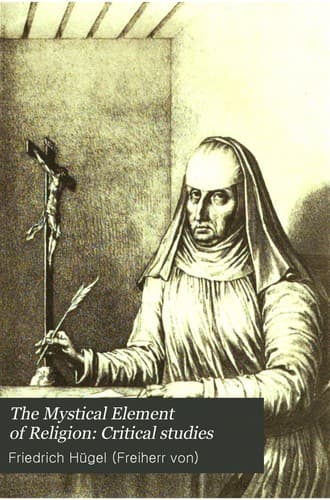
The Mystical Element of Religion, as studied in Saint Catherine of Genoa and her friends, Volume 2 (of 2)Hügel, Friedrich, Freiherr von
Religion
The Mystical Element of Religion, as studied in Saint Catherine of Genoa and her friends, Volume 2 (of 2)
Hügel, Friedrich, Freiherr von
Catherine, of Genoa, Saint, 1447-1510
Now it is certain that Catherine, up to ten years before, had been
full of definitely religious acts and dispositions. Had she not,
already at thirteen, wanted to be a Nun, and, at eight or so, been
deeply moved by a picture of the dead Christ in His Mother’s lap?
Hence, ideas and feelings of self-dedication and of the Christ-God’s
hatred of sin and love for her had, in earlier and during longer times
than those of her comparative carelessness, soaked into and formed her
mental and emotional bent, and will have in so far shaped her will,
as to make the later determination along those earlier lines of its
operation, comparatively easy, even after those years of relaxation and
deviation. Yet it is clear that there was not here, as indeed there
is nowhere, any mere repetition of the past. New combinations and an
indefinitely deeper apprehension of the great religious ideas and facts
of God’s holiness and man’s weakness, of the necessity for the soul to
reach its own true depth or to suffer fruitlessly, and of God having
Himself to meet and feed this movement and hunger which He has Himself
implanted; new combinations and depths of emotion, and an indefinite
expansion and heroic determination of the will: were all certainly
here, and were new as compared with even the most religious moments in
the past.
As to the suddenness, we cannot but take it as, in large part, simply
apparent,--a dim apprehension of what then became clear having been
previously quite oppressively with her. And, in any case, this
suddenness seems to belong rather to the temperamental peculiarities
and necessary forms of her particular experiences than to the essence
and content of her spiritual life. For, whatever she thinks, feels,
says or does throughout her life, she does and experiences with actual
suddenness, or at least with a sense of suddenness; and there is
clearly no more necessary connection between such suddenness and grace
and true self-renouncement, than there is between gradualness and mere
nature; both suddenness and gradualness being but simple modes, more or
less fixed for each individual, yet differing from each to each, modes
in which God’s grace and man’s will interact and manifest themselves in
different souls.[35]
Public-domain text, read in full here on John Shaqi.
Reviews
Reviews
No reviews yet
Be the first to share your thoughts on this work.
Join the Discussion
Join the discussion
Sign in to leave a comment or review.
Sign InorCreate an account