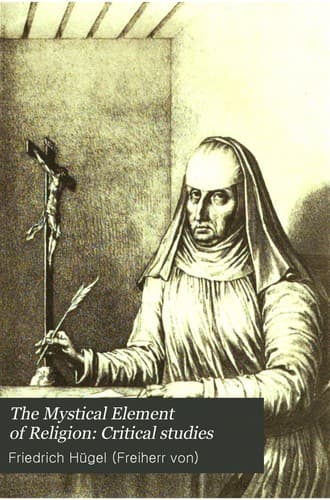
The Mystical Element of Religion, as studied in Saint Catherine of Genoa and her friends, Volume 2 (of 2)Hügel, Friedrich, Freiherr von
Religion
The Mystical Element of Religion, as studied in Saint Catherine of Genoa and her friends, Volume 2 (of 2)
Hügel, Friedrich, Freiherr von
Catherine, of Genoa, Saint, 1447-1510
And in Catherine’s case her special temperament; her particular
attitude during the ten years’ laxity, and again during the last years’
times of obscurity and scruple; even some of her sayings probably
still belonging to this middle period; but above all the precise point
and edge of her counter-ideal and _attrait_: all indicate clearly
enough what was her congenital defect. A great self-engrossment of
a downrightly selfish kind; a grouping of all things round such a
self-adoring _Ego_; a noiseless but determined elimination from
her life and memory of all that would not or could not, then and
there, be drawn and woven into the organism and functioning of this
immensely self-seeking, infinitely woundable and wounded, endlessly
self-doctoring “I” and “Me”: a self intensely, although not sexually,
jealous, envious and exacting, incapable of easy accommodation, of
pleasure in half successes, of humour and brightness, of joyous
“once-born” creatureliness: all this was certainly to be found, in
strong tendency at least, in the untrained parts and periods of her
character and life.
And then the same peculiarity and sensitiveness of her psycho-physical
organism which, in her last period, ended by mirroring her mental
spiritual apprehensions and picturings in her very body, and which,
even at this time, has been traced by us in the curious long fixities
and rapid changes of her fields of consciousness, clearly operates
also and already here, in separating off this false self from the good
one and in heightening the apprehension of that false self to almost a
perception in space, or to an all but physical sensation.
We thus get something of which the interesting cases of “doubleness
of personality,” so much studied of late years, are, as it were,
purely psychical, definitely _maladif_ caricatures; the great
difference consisting in Catherine herself possessing, at all times,
the consciousness and memory of both sides, of both “selves,” and of
each as both actual and potential, within the range of her one great
personality. Indeed it is this very multiplicity thus englobed and
utilized by that higher unity, which gives depth to her sanity and
sanctity.[37]
5. _Precise object and end of her striving._
And all this is confirmed and completed, as already hinted, by the
precise object of her ideal, the particular means and special end of
the struggle. Here, at the very culmination of her inner life and
aim, we find the deepest traces of her temperamental requirements;
and here, in what she seeks, there is again an immense concentration
and a significant choice. The distinctions between obligation and
supererogation, between merit and grace, are not utilized but
transcended; the conception of God having anger as well as love arouses
as keen a sense of intolerableness as that of God’s envy aroused in
Plato, and God appears to her as, in Himself, continuously loving.
Public-domain text, read in full here on John Shaqi.
Reviews
Reviews
No reviews yet
Be the first to share your thoughts on this work.
Join the Discussion
Join the discussion
Sign in to leave a comment or review.
Sign InorCreate an account