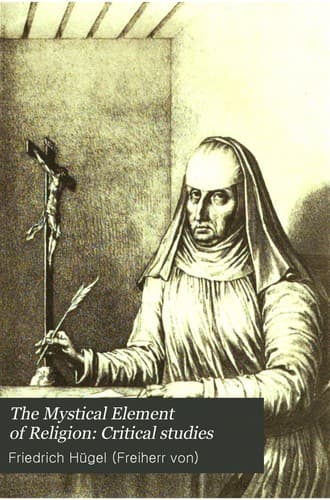
The Mystical Element of Religion, as studied in Saint Catherine of Genoa and her friends, Volume 2 (of 2) — John Shaqi
The Mystical Element of Religion, as studied in Saint Catherine of Genoa and her friends, Volume 2 (of 2)Hügel, Friedrich, Freiherr von
Religion
The Mystical Element of Religion, as studied in Saint Catherine of Genoa and her friends, Volume 2 (of 2)
Hügel, Friedrich, Freiherr von
Catherine, of Genoa, Saint, 1447-1510
And her second peculiarity of religious practice was her great
simplification and intensification of the spiritual combat.
Simplification: for she does not fight directly either the Devil or the
World; she directly fights the “Flesh” alone, and recognizes but one
immediate opponent, her own lower self. Hence the references to the
world are always simply as to an extension or indefinite repetition
of that same self, or of similar lower selves; and those to the devil
are, except where she declares her own lower self “a very devil,”
extraordinarily rare, and, in their authentic forms, never directly and
formally connected with her own spiritual interests and struggles.
And Intensification: for she conceives this lower self, against which
all her fighting is turned, as capable of any enormity, as actually
cloaking itself successively in every kind of disguise, and as more or
less vitiating even the most spiritual-seeming of her states and acts.
And here again we can, I think, clearly trace the influence of her
special temperament and psycho-physical functioning, yet in a direction
opposite to that in which we would naturally expect it. For it is not
so much that this temperament led her to exaggerate the badness of her
false self, or to elaborate a myth concerning its (all but completely
separate) existence, as that, owing in large part to that temperament
and functioning, her false self _was_ both unusually distinct from her
true self and particularly clamorous and claimful. It would indeed be
well for hagiography if, in all cases, at least an attempt were made to
discover and present the precise and particular good and bad selves,
worked for and fought by the particular saint: for it is just this
double particularization of the common warfare in every individual soul
that gives the poignant interest and instructiveness, and a bracing
sense of reality to these lonely yet typical, unique yet universal
struggles, defeats, and victories.
Public-domain text, read in full here on John Shaqi.
Reviews
Reviews
No reviews yet
Be the first to share your thoughts on this work.
Join the Discussion
Join the discussion
Sign in to leave a comment or review.
Sign InorCreate an account