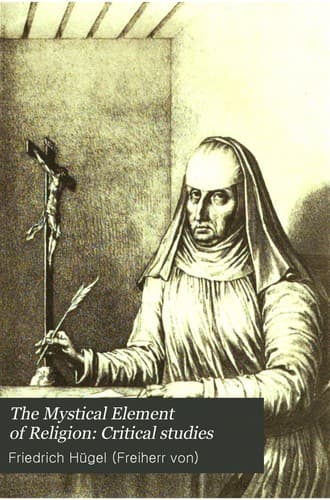
The Mystical Element of Religion, as studied in Saint Catherine of Genoa and her friends, Volume 2 (of 2)Hügel, Friedrich, Freiherr von
Religion
The Mystical Element of Religion, as studied in Saint Catherine of Genoa and her friends, Volume 2 (of 2)
Hügel, Friedrich, Freiherr von
Catherine, of Genoa, Saint, 1447-1510
Yet these attacks were evidently somehow connected, both in fact and
in his consciousness, with his Visions; and they were recurrent. The
vision of the Third Heaven and his apparently first attack seem to have
been practically coincident,--about A.D. 44. We find a second attack
hanging about him for some time, on his first preaching in Galatia,
about A.D. 51 or 52 (see 1 Thess. ii, 18; 1 Cor. ii, 3). And a third
attack appears to have come in A.D. 57 or 58, when the Second Epistle
to the Corinthians and that to the Galatians were written; note the
words (2 Cor. i, 9), “But” (in addition to his share in the public
persecution) “we ourselves had the sentence of death within ourselves,
in order that we might not trust in ourselves but in God who raiseth
the dead to life.” (And compare here St. Teresa: in July 1547 “for
about four days I remained insensible. They must have regarded me as
dead more than once. For a day and a half the grave was open in my
monastery, waiting for my body. But it pleased Our Lord I should come
to myself.”)[42] Dr. Lightfoot gives as a parallel the epileptiform
seizures of King Alfred, which, sudden, acutely painful, at times
death-like, and protracted, tended to render the royal power despicable
in the eyes of the world.[43] Yet, except for the difference of sex and
of relative privacy, St. Teresa’s states, which I have given here, are
more closely similar, in so much as they are intimately connected with
religious visions and voices.
And, amongst Old Testament figures, we can find a similar connection,
on a still larger scale, in the case of Ezekiel, the most definitely
ecstatic, though (upon the whole) the least original, of the literary
Prophets. For, as to the visionary element, we have his own records
of three visions of the glory of Jahve; of five other ecstasies,
three of which are accompanied by remarkable telepathic, second-sight
activities; and of twelve symbolic (better: representative) prophetic
actions, which are now all rightly coming to be considered as having
been externally carried out by him.[44] And we get psycho-physical
states, as marked as in any other ecstatic saint. For we hear how Jahve
on one occasion says to him: “But thou, son of man, lay thyself on
thy left side” (_i.e._ according to Jewish orientation, towards the
North) “and I shall lay the guilt of the house of Israel” (the Northern
Kingdom) “upon thee; the number of days that thou shalt lie upon it,
shalt thou bear their guilt. But I appoint unto thee the years of their
guilt, as a (corresponding) number of days, (namely) one hundred and
fifty days.… And, when thou hast done with them, thou shalt lay thyself
on thy right side” (_i.e._ towards the South), “and thou shalt bear the
guilt of the house of Judah” (the Southern Kingdom); “one day for each
year shall I appoint unto thee. And behold I shall lay cords upon thee,
that thou shalt be unable to turn from one side to the other, till thou
Public-domain text, read in full here on John Shaqi.
Reviews
Reviews
No reviews yet
Be the first to share your thoughts on this work.
Join the Discussion
Join the discussion
Sign in to leave a comment or review.
Sign InorCreate an account