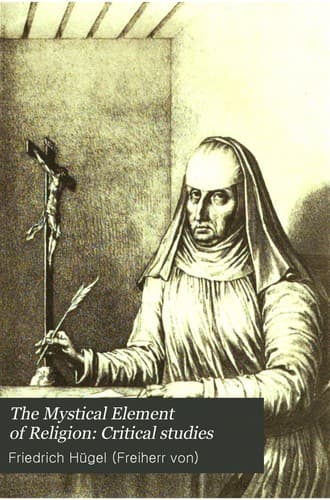
The Mystical Element of Religion, as studied in Saint Catherine of Genoa and her friends, Volume 2 (of 2)Hügel, Friedrich, Freiherr von
Religion
The Mystical Element of Religion, as studied in Saint Catherine of Genoa and her friends, Volume 2 (of 2)
Hügel, Friedrich, Freiherr von
Catherine, of Genoa, Saint, 1447-1510
Now the most ancient interpretation of this “thorn” or “stake” is some
kind of bodily complaint,--violent headache or earache is mentioned by
Tertullian de Pudicitia, 13, and by St. Jerome, Comm. in Gal. _loc.
cit._ Indeed St. Paul’s own description of his “bodily presence” as
“weak,” and his “spoken word” as “contemptible” (2 Cor. x, 10), points
this way. It seems plain that it cannot have been carnal temptations
(only in the sixth century did this interpretation become firmly
established), for he could not have gloried in these, nor could they,
hidden as they would be within his heart, have exposed him to the
contempt of others. Indeed he expressly excludes such troubles from his
life, where, in advising those who were thus oppressed to marry, he
gives the preference to the single life, and declares, “I would that
all men were even as myself” (1 Cor. vii, 7).
The attacks of this trouble were evidently acutely painful: note the
metaphor of a stake driven into the live flesh and the Angel of Satan
who buffeted him. (And compare St. Teresa’s account: “An Angel of God
appeared to me to be thrusting at times a long spear into my heart and
to pierce my very entrails”; “the pain was so great that it made me
moan”; “it really seems to the soul as if an arrow were thrust through
the heart or through itself; the suffering is not one of sense, neither
is the wound physical”; and how, on another occasion, she heard Our
Lord answer her: “Serve thou Me, and meddle not with this.”)[40]
These attacks would come suddenly, even in the course of his public
ministry, rendering him, in so far, an object of derision and of
loathing. (Compare here St. Teresa’s declaration: “During the rapture,
the body is very often perfectly powerless; it continues in the
position it was in when the rapture came upon it: if sitting, sitting;
if the hands were open, or if they were shut, they will remain open or
shut”; “if the body” was “standing or kneeling, it remains so.”)[41]
Public-domain text, read in full here on John Shaqi.
Reviews
Reviews
No reviews yet
Be the first to share your thoughts on this work.
Join the Discussion
Join the discussion
Sign in to leave a comment or review.
Sign InorCreate an account