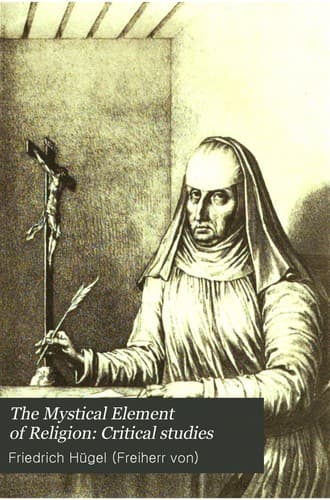
The Mystical Element of Religion, as studied in Saint Catherine of Genoa and her friends, Volume 2 (of 2)Hügel, Friedrich, Freiherr von
Religion
The Mystical Element of Religion, as studied in Saint Catherine of Genoa and her friends, Volume 2 (of 2)
Hügel, Friedrich, Freiherr von
Catherine, of Genoa, Saint, 1447-1510
And Conscience, “Syneidēsis”--that late Greek word introduced
by St. Paul as a technical term into the Christian
vocabulary--includes our “conscience,” but is as comprehensive as
our “consciousness.”--Catherine practically never uses the term: no
doubt because, in the narrower of the two senses which had become
the ordinary one, it was too predominantly ethical to satisfy her
overwhelmingly religious preoccupations.
(3) Now, with regard to this whole dualism of the “outer” and the
“inner man,” its application to the resurrection of the body in
St. Paul and in St. Catherine shall occupy us in connection with
her Eschatology; here I would but indicate the two Pauline moods
or attitudes towards the earthly body, and Catherine’s continuous
reproduction of but one of these. For his magnificent conception of the
Christian society, in which each person, by a different specific gift
and duty, co-operates towards the production of an organic whole, a
whole which in return develops and dignifies those its constituents,
is worked out by means of the image of the human earthly body, in
which each member is a necessary part and constituent of the complete
organism, which is greater than, and which gives full dignity to,
each and all these its factors (1 Cor. xii). And he thus, in his most
deliberate and systematic mood, shows very clearly how deeply he has
realized the dignity of the human body, as the instrument both for the
development of the soul itself and for the work of that soul in and
upon the visible world.
But in his other mood, which remains secondary and sporadic throughout
his writings, his attitude is acutely dualistic. His one direct
expression of it occurs in 2 Cor. v, 1-4: “For we know that, if our
earthly house of this tent be dissolved, we have a building of God, a
house not made with hands, eternal in the heavens. For in this also we
groan, desiring to be clothed upon with our habitation that is from
heaven. We who are in this tabernacle do groan, being burthened.” Now
this passage is undoubtedly modelled by St. Paul upon the Book of
Wisdom, ix, 15: “For the corruptible body is a load upon the soul, and
the earthly habitation presseth down the mind that museth upon many
things.” And this latter saying again is as certainly formed upon Plato
(_Phaedo_, 81 _c_): “It behoves us to think of the body as oppressive
and heavy and earthlike and visible. And hence the soul, being of
such a nature as we have seen, when possessing such a body, is both
burthened and dragged down again into the visible world.”[65] And it is
this conception of the Hellenic Athenian Plato (about 380 B.C.) which,
passing through the Hellenistic Alexandrian Jewish Wisdom-writer (80
B.C.?) and then through the Hellenistically tinctured ex-Rabbi, Paul
of Tarsus (52 A.D.), still powerfully, indeed all but continuously,
influences the mind of the Genoese Christian Catherine, especially
during the years from A.D. 1496 to 1510.
Public-domain text, read in full here on John Shaqi.
Reviews
Reviews
No reviews yet
Be the first to share your thoughts on this work.
Elsewhere in the archive
Join the Discussion
Join the discussion
Sign in to leave a comment or review.
Sign InorCreate an account