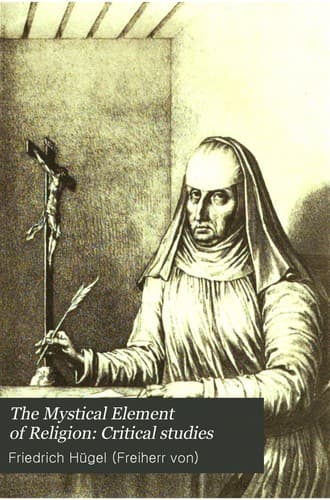
The Mystical Element of Religion, as studied in Saint Catherine of Genoa and her friends, Volume 2 (of 2)Hügel, Friedrich, Freiherr von
Religion
The Mystical Element of Religion, as studied in Saint Catherine of Genoa and her friends, Volume 2 (of 2)
Hügel, Friedrich, Freiherr von
Catherine, of Genoa, Saint, 1447-1510
And lastly, the very closeness with which modern experimental and
analytical psychology is exploring the phenomena of our consciousness
is once more bringing into ever-clearer relief the irrepressible
metaphysical apprehensions and affirmations involved and implied by
the experience of every human mind, from its first dim apprehension
in infancy of a “something,” as yet undifferentiated by it into
subjective and objective, up to its mature and reflective affirmation
of the trans-subjective validity of its “positions,” or at least of its
negations--pure scepticism turning out to be practically impossible.
Here we have, with respect to that apprehension, such admirable workers
as Henri Bergson in France, and Professors Henry Jones and James
Ward in England; and, for this affirmation, such striking thinkers
as the French Maurice Blondel, and the Germans Johannes Volkelt and
Hugo Münsterberg. And Mgr. Mercier of Louvain, now Cardinal Mercier,
has contributed some valuable criticism of certain points in these
positions.[11]
5. _Difficulties of this inquiry._
Now here I am met at once by two special difficulties, the one
personal to myself and to Catherine, and the other one of method.
For, with regard to those three first sets of recent explorations of
a psycho-physical kind, I am no physician at all, and not primarily
a psychologist. And again, in Catherine’s instance, the evidence as
to her psycho-physical states is not, as with St. Teresa and some few
other cases, furnished by writings from the pen of the very person who
experienced them, and it is at all copious and precise only for the
period when she was admittedly ill and physically incapacitated.--And
yet these last thirteen years of her life occupy a most prominent
place in her biography; it is during, and on occasion of, those
psycho-physical states, and largely with the materials furnished by
them, that, precisely in those years, she built up her noblest legacy,
her great Purgatorial teaching; the illness was (quite evidently) of a
predominantly psychical type, and concerns more the psychologist than
the physician, being closely connected with her particular temperament
and type of spirituality, a temperament and type to be found again and
again among the Saints. All this and more makes it simply impossible
for me to shrink from some study of the matter, and permits me to hope
for some success in attempting, slowly and cautiously, to arrive at
certain general conclusions of a spiritually important kind.
Public-domain text, read in full here on John Shaqi.
Reviews
Reviews
No reviews yet
Be the first to share your thoughts on this work.
Join the Discussion
Join the discussion
Sign in to leave a comment or review.
Sign InorCreate an account