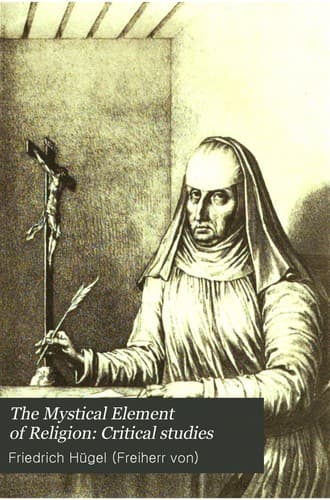
The Mystical Element of Religion, as studied in Saint Catherine of Genoa and her friends, Volume 2 (of 2)Hügel, Friedrich, Freiherr von
Religion
The Mystical Element of Religion, as studied in Saint Catherine of Genoa and her friends, Volume 2 (of 2)
Hügel, Friedrich, Freiherr von
Catherine, of Genoa, Saint, 1447-1510
4. _Permanent values of the ancient theory._
And yet that old position with regard to the rarer psycho-physical
states has a right to our respectful and sympathetic study.
For one thing, we are now coming again to recognize, more and more,
how real and remarkable are certain psycho-physical states and facts,
whether simply morbid or fruitfully utilized states, so long derided,
by the bulk of Scientists, as mere childish legend or deliberate
imposture; and to see how natural, indeed inevitable it was, that
these, at that time quite inexplicable, things should have been
attributed to a direct and discontinuous kind of Divine intervention.
We, on our part, have then to guard against the Philistinism both
of the Rationalists and of the older Supernaturalists, and will
neither measure our assent to facts by our ability to explain them,
nor postulate the unmediated action of God wherever our powers of
explanation fail us. On this point we have admirable models of
sympathetic docility towards facts, in the works of Prof. Pierre Janet,
in his medico-psychological investigations of present-day morbid
cases; of Hermann Gunkel and Heinrich Weinel, in their examination of
mostly healthy psycho-physical phenomena in early Christian times and
writings; and of William James, in his study of instances of various
kinds, both past and present.[8]
And next, these (at first sight physical) phenomena are turning out,
more and more, to be the direct or indirect consequence of the action
of mind: no doubt, in the first instance, of the human mind, but still
of mind, both free-willing and automatically operative. And at the same
time this action is, more and more, seen to be limited and variously
occasioned by the physical organism, and to be accompanied or followed,
in a determinist fashion, by certain changes in that organism. Yet if
we have now immeasurably more knowledge than men had, even fifty years
ago, of this latter ceaselessly active, limiting, occasioning influence
of the body upon the mind, we have also immeasurably more precise and
numerous facts and knowledge in testimony of the all but boundless
effect of mind over body. Here, again, Prof. Janet’s writings, those
of Alfred Binet, and the Dominican Père Coconnier’s very sensible book
register a mass of material, although of the morbid type.[9]
And further, such remarkable peripheral states and phenomena are
getting again to be rightly looked for in at least some types of
unusual spiritual insight and power (although such states are found to
be indicative, in exact proportion to the spiritual greatness of their
subject, of a substantially different mental and moral condition of
soul). Witness again the Unitarian Prof. James’s _Varieties_, and the
Church-Historical works of the Broad Lutheran German scholars Weinel,
Bernoulli, and Duhm.[10]
Public-domain text, read in full here on John Shaqi.
Reviews
Reviews
No reviews yet
Be the first to share your thoughts on this work.
Join the Discussion
Join the discussion
Sign in to leave a comment or review.
Sign InorCreate an account