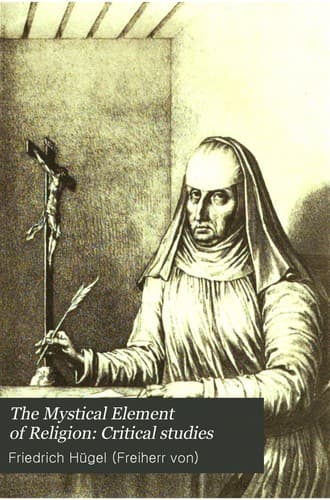
The Mystical Element of Religion, as studied in Saint Catherine of Genoa and her friends, Volume 2 (of 2)Hügel, Friedrich, Freiherr von
Religion
The Mystical Element of Religion, as studied in Saint Catherine of Genoa and her friends, Volume 2 (of 2)
Hügel, Friedrich, Freiherr von
Catherine, of Genoa, Saint, 1447-1510
The second couple conceives Sanctification either juridically, and
moves dramatically from act to act,--the Sacrifice on the Cross and
the Resurrection of the Son of God, the sentence of Justification and
the Adoption as sons of God; or ethically, and presupposes everywhere
continuous processes,--beginning with the reception of the Spirit, and
ending with “the Lord of the Spirit.”--Here Catherine has curiously
little of the dramatic and prominently personal conception: only in
the imperfect soul’s acutely painful moment, of standing before and
seeing God immediately after death, do we get one link in this chain,
in a somewhat modified form. For the rest, the ethical and continuous
conception is present practically throughout her teaching, but in a
curious, apparently paradoxical form, to be noticed in a minute.
And the third couple either treats Sanctification as, at each moment of
its actual presence, practically infallible and complete: “We who have
died to sin, how shall we further live in it?” “Freed from sin, ye have
become the servants of Justice”; “now we are loosed from the law of
death, so as to serve in newness of spirit”; “those who are according
to the flesh, mind the things of the flesh; but they that are according
to the Spirit, mind the things of the Spirit,” Rom. vi, 2, 18; vii, 6;
viii, 5. Or it considers Sanctification as only approximately complete,
so long as man has to live here below, not only in the Spirit, Rom.
viii, 9, but also in the flesh, Gal. ii, 20. The faithful have indeed
crucified the flesh once for all, Gal. v, 24: yet they have continually
to mortify their members anew, Col. iii, 5, and by the Spirit to
destroy the works of the flesh, Rom. viii, 13. The “fear of the Lord,”
“of God,” does not cease to be a motive for the sanctified, 2 Cor. v,
11; vii, 1. To “walk in the Spirit,” “in the light,” has to be insisted
on (1 Thess. v, 4-8; Rom. xiii, 11-14; 2 Cor. vi, 14), as long as the
eternal day has not yet arisen for us. And even in Romans, chapter
vi, we find admonitions, vv. 12, 13, 19, which, if we press the other
conception, are quite superfluous.[68]
Public-domain text, read in full here on John Shaqi.
Reviews
Reviews
No reviews yet
Be the first to share your thoughts on this work.
Elsewhere in the archive
Join the Discussion
Join the discussion
Sign in to leave a comment or review.
Sign InorCreate an account