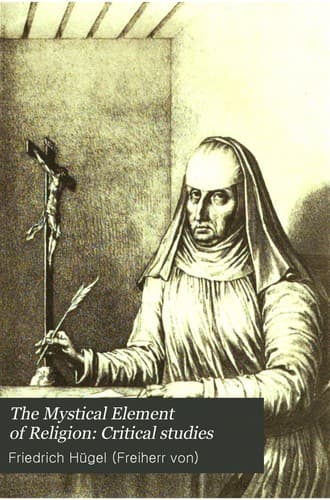
The Mystical Element of Religion, as studied in Saint Catherine of Genoa and her friends, Volume 2 (of 2)Hügel, Friedrich, Freiherr von
Religion
The Mystical Element of Religion, as studied in Saint Catherine of Genoa and her friends, Volume 2 (of 2)
Hügel, Friedrich, Freiherr von
Catherine, of Genoa, Saint, 1447-1510
And here Catherine, in her intense sympathy with each of these
contrasted conceptions, offers us a combination of both in a state
of unstable equilibrium and delicate tension. I take it that it is
not her immensely impulsive and impatient temperament, nor survivals
of the Old Testament idea as to instantaneousness being the special
characteristic of divine action, but her deep and noble sense of the
givenness and pure grace of religion, and of God’s omnipotence being,
if possible, exceeded only by His overflowing, self-communicative
love, which chiefly determine her curious presentation and emotional
experience of spiritual growth and life as a movement composed of
sudden shiftings upwards, with long, apparently complete pauses in
between. For here this form (of so many instants, of which each is
complete in itself) stands for her as the least inadequate symbol, as a
kind of shattered mirror, not of time at all, but of eternity; whilst
the succession and difference between these instants indicates a growth
in the apprehending soul, which has, in reality, been proceeding also
in between these instants and not only during them. And this remarkable
scheme presents her conviction that, in principle, the work of the
all-powerful, all-loving Spirit cannot, of itself, be other than final
and complete, and yet that, as a matter of fact, it never is so, in
weak, self-deceptive, and variously resisting man, but ever turns
out to require a fresh and deeper application. And this succession
of sudden jerks onwards and upwards, after long, apparently complete
pauses between them, gives to her fundamentally ethical and continuous
conception something of the look of the forensic, dramatic series,
with its separate acts,--a series which would otherwise be all but
unrepresented in her picture of the soul’s life on this side of death
and of its life (immediately after its vivid sight of God and itself,
and its act of free-election) in the Beyond.
6. _Pauline Social Ethics._
As to Social Ethics, St. Paul’s worldward movement is strongly
represented in Catherine’s teaching. Her great sayings as to God being
servable not only in the married state, but in a camp of (mercenary)
soldiers; and as to her determination violently to appropriate the
monk’s cowl, should this his state be necessary to the attainment of
the highest love of God, are full of the tone of Rom. xiv, 14, 20,
“nothing is common in itself, but to him who considereth anything to be
common, to him it is common,”--“all things are clean”; and of 1 Cor.
x, 26, 28, “the earth is the Lord’s, and the fulness thereof.” And her
sense of her soul’s positive relation to nature, _e.g._ trees, was no
doubt in part awakened by that striking passage, Rom. viii, 19, “the
expectation of the creature awaiteth the revelation of the sons of God;
for the creature was made subject to vanity not willingly.”
Public-domain text, read in full here on John Shaqi.
Reviews
Reviews
No reviews yet
Be the first to share your thoughts on this work.
Elsewhere in the archive
Join the Discussion
Join the discussion
Sign in to leave a comment or review.
Sign InorCreate an account