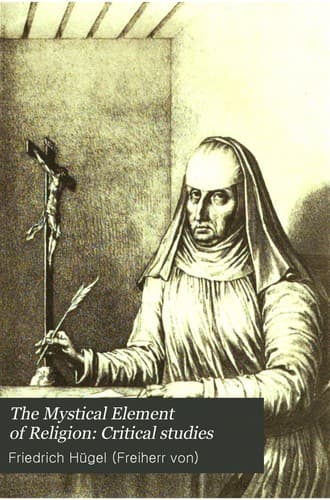
The Mystical Element of Religion, as studied in Saint Catherine of Genoa and her friends, Volume 2 (of 2)Hügel, Friedrich, Freiherr von
Religion
The Mystical Element of Religion, as studied in Saint Catherine of Genoa and her friends, Volume 2 (of 2)
Hügel, Friedrich, Freiherr von
Catherine, of Genoa, Saint, 1447-1510
(2) With regard to Paulinism, the Joannine writings give us a
continuation and extension of the representation of the soul’s mystical
union with Christ, as a local abiding in the element Christ. Indeed
it is in these writings that we find the terms “to abide in” the
light, 1 John ii, 10, in God, 1 John iv, 13, in Christ, 1 John ii, 6,
24, 27, iii, 6, 24, and in His love, John xv, 9, 1 John iv, 16; the
corresponding expressions, “God abideth in us,” 1 John iv, 12, 16,
“Christ abideth in us,” 1 John iii, 24, and “love abideth in us,” 1
John iv, 16; the two immanences coupled together, where the communicant
“abideth in Me and I in him,” vi, 56, and where the members of His
mystical body are bidden to “abide in Me and I in you,” xv, 4; and the
supreme pattern of all these interpenetrations, “I am in the Father,
and the Father is in Me,” xiv, 10.--And it is from here that Catherine
primarily gets the literary suggestions for her images of the soul
plunged into, and filled by, an ocean of Light, Love, Christ, God; and
again from here, more than from St. Paul, she gets her favourite term
μένειν (It. _restare_), around which are grouped, in her mind, most of
the quietistic-sounding elements of her teaching.
(3) As to the points of contact between the Joannine teaching and
Alexandrianism, we find that three are vividly renewed by Catherine.
Philo had taught: “God ceases not from acting: as to burn is the
property of fire, so to act is the property of God,” _Legg. Alleg._ I,
3. And in John we find: “God is a Spirit,” and “My Father worketh ever
and I work ever,” iv, 24; v, 17. And God as pure Spiritual Energy, as
the _Actus Purus_, is a truth and experience that penetrates the whole
life of Catherine.
The work of Christ is not dwelt on in its earthly beginnings; but it is
traced up and back, in the form of a spiritual “Genesis,” to His life
and work as the Logos in Heaven, where He abides “in the bosom of the
Father,” and whence He learns what He “hath declared” to us, i, 18;
just as, in his turn, the disciple whom Jesus loved “was reclining” at
the Last Supper “on the bosom of Jesus,” and later on “beareth witness
concerning the things” which he had learnt there, xiii, 23; xxi, 24. So
also Catherine transcends the early earthly life of Christ altogether,
and habitually dwells upon Him as the Light and as Love, as God in His
own Self-Manifestation; and upon the ever-abiding sustenance afforded
by this Light and Life and Love to the faithful soul reclining and
resting upon it.
Public-domain text, read in full here on John Shaqi.
Reviews
Reviews
No reviews yet
Be the first to share your thoughts on this work.
Elsewhere in the archive
Join the Discussion
Join the discussion
Sign in to leave a comment or review.
Sign InorCreate an account