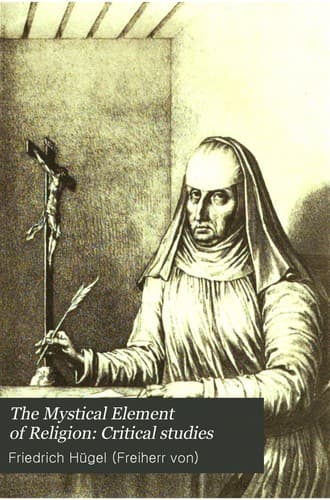
The Mystical Element of Religion, as studied in Saint Catherine of Genoa and her friends, Volume 2 (of 2)Hügel, Friedrich, Freiherr von
Religion
The Mystical Element of Religion, as studied in Saint Catherine of Genoa and her friends, Volume 2 (of 2)
Hügel, Friedrich, Freiherr von
Catherine, of Genoa, Saint, 1447-1510
And the contrast between the Spiritual and the Material, the Abiding
and the Transitory, is symbolized throughout John, in exact accord
with Philo, under the spacial categories of upper and lower, and of
extension: “Ye are from below, I am from above,” viii, 23; “He that
cometh from above, is above all,” iv, 31; and “in my Father’s house,”
that upper world, “there are many mansions,” abiding-places, xiv,
2. Hence all things divine here below have descended from above:
regeneration, iii, 3; the Spirit, i, 32; Angels, i, 51; the Son of God
Himself, iii, 13: and they mount once more up above, so especially
Christ Himself, iii, 13; vi, 62. And the things of that upper world
are the true things: “the true light,” “ the true adorers,” “the
true vine,” “the true bread from Heaven,” i, ix; iv, 23; xv, 1; vi,
32: all this in contrast to the shadowy semi-realities of the lower
world.--Catherine is here in fullest accord with the spacial imagery
generally; she even talks of God Himself, not only as in a place, but
as Himself a place, as the soul’s “loco.” But she has, for reasons
explained elsewhere, generally to abandon the upper-and-lower category
when picturing the soul’s self-dedication to purification, since, for
this act, she mostly figures a downward plunge into suffering; and
she gives us a number of striking sayings, in which she explicitly
re-translates all this quantitative spacial imagery into its underlying
meaning of qualitative spiritual states.
(4) As to the Joannine approximations and antagonisms to Gnosticism,
Catherine’s position is as follows. In the Synoptic accounts, Our Lord
makes the acquisition of eternal life depend upon the keeping of the
two great commandments of the love of God and of one’s neighbour, Luke
x, 26-28, and parallels. In John Our Lord says: “this is eternal life,
that they may know Thee, the only true God and Jesus Christ whom Thou
hast sent,” xvii, 3. To “know,” γινώσκειν, occurs twenty-five times in
1 John alone. Here the final object of every soul is to believe and to
know: “they received and knew truly and believed,” xvii, 8; “we have
believed and have known,” vi, 69; or “we have known and have believed,”
1 John iv, 16. And Catherine also lays much stress upon faith ending,
even here below, in a certain vivid knowledge; but this knowledge is,
with her, less doctrinally articulated, no doubt in part because there
was no Gnosticism fronting her, to force on such articulation.
Public-domain text, read in full here on John Shaqi.
Reviews
Reviews
No reviews yet
Be the first to share your thoughts on this work.
Elsewhere in the archive
Join the Discussion
Join the discussion
Sign in to leave a comment or review.
Sign InorCreate an account