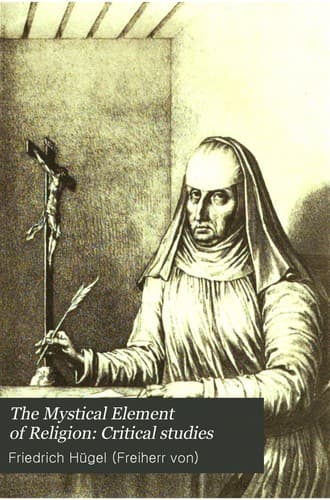
The Mystical Element of Religion, as studied in Saint Catherine of Genoa and her friends, Volume 2 (of 2)Hügel, Friedrich, Freiherr von
Religion
The Mystical Element of Religion, as studied in Saint Catherine of Genoa and her friends, Volume 2 (of 2)
Hügel, Friedrich, Freiherr von
Catherine, of Genoa, Saint, 1447-1510
And the Joannine writings compare this higher mental knowledge to the
lower, sensible perception: “He who cometh from heaven, witnesseth to
what he hath seen and heard,” iii, 31; “when He shall become manifest,
we shall see Him as He is,” 1 John iii, 2. And they have three special
terms, in common with Gnosticism, for the object of such knowledge:
Life, Light, and Fulness (_Plerōma_),--the latter, as a technical term,
appearing in the New Testament only in John i, 16, and in the Epistles
to the Colossians and Ephesians. Catherine, also, is ever experiencing
and conceiving the mental apprehensions of faith, as so many
quasi-sensible, ocular, perceptions; and Life and Light are constantly
mentioned, and Fulness is, at least, implied in the psycho-physical
concomitants or consequences of her thinkings.
On the other hand, she does not follow John in the intensely dualistic
elements of his teaching,--the sort of determinist, all but innate,
distinction between “the darkness,” “the men who loved the darkness
rather than the light,” and the Light itself and those who loved it, i,
4, 5; iii, 19,--children of God and children of the devil--the latter
all but incapable of being saved, viii, 38-47; x, 26; xi, 52; xiv,
17. Rather is she like him in his all but complete silence as to “the
anger of God,”--a term which he uses once only, iii, 36, as against the
twenty-two instances of it in St. Paul.
And she is full to overflowing of the great central, profoundly un- and
anti-Gnostic, sensitively Christian teachings of St. John: as to the
Light, the only-begotten Son, having been given by God, because God so
loved the world; as to Jesus having loved his own even to the end; as
to the object of Christ’s manifestation of His Father’s name to men,
being that God’s love for Christ, and indeed Christ Himself, might
be within them; and as to how, if they love Him, they will keep His
commandments,--His commandment to love each other as He has loved them,
iii, 21; iii, 16; xiii, 1; xvii, 26; xiv, 15; xv, 17. In this last
great declaration especially do we find the very epitome of Catherine’s
life and spirit, of her who can never think of Him as Light and
Knowledge only, but ever insists on His being Fire and Love as well;
and who has but one commandment, that of Love-impelled, Love-seeking
loving.
(5) And lastly, in relation to organized, Ecclesiastical Christianity,
the Joannine writings dwell, as regards the more general principles, on
points which, where positive, are simply presupposed by Catherine; and,
where negative, find no echo within her.
Public-domain text, read in full here on John Shaqi.
Reviews
Reviews
No reviews yet
Be the first to share your thoughts on this work.
Elsewhere in the archive
Join the Discussion
Join the discussion
Sign in to leave a comment or review.
Sign InorCreate an account