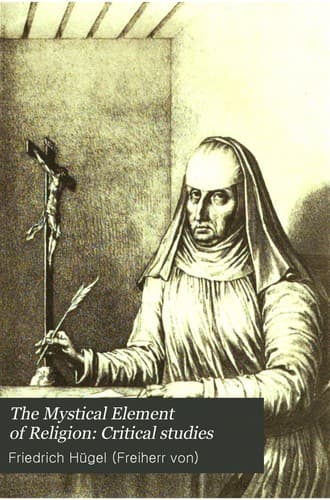
The Mystical Element of Religion, as studied in Saint Catherine of Genoa and her friends, Volume 2 (of 2)Hügel, Friedrich, Freiherr von
Religion
The Mystical Element of Religion, as studied in Saint Catherine of Genoa and her friends, Volume 2 (of 2)
Hügel, Friedrich, Freiherr von
Catherine, of Genoa, Saint, 1447-1510
The Joannine writings insist continually upon the unity and
inter-communion of the faithful: “There shall be one fold, one
shepherd”; Christ’s death was in order “that He might gather the
scattered children of God into one”; He prays to the Father that
believers “may be one, as we are one”; and He leaves as His legacy
His seamless robe, x, 16; xi, 52; xvii, 21; xix, 24. And these same
writings have a painfully absolute condemnation for all outside of
this visible fold: “The whole world lies in evil”; its “Prince is the
Devil”; “the blood of Jesus cleanseth us from all sin,” within the
community alone; false prophets, those who have gone forth from the
community, are not to be prayed for, are not even to be saluted, 1
John, v, 19; John xii, 31; John i, 7; v, 16; 2 John, 10. For the great
and necessary fight with Gnosticism has already begun in these writings.
But Catherine dies before the unity of Christendom is again in jeopardy
through the Protestant Reformation, and she never dwells--this is
doubtless a limit--upon the Christian community, as such. And her
enthusiastic sympathy with the spiritual teachings of Jacopone da
Todi, who, some two centuries before, had, as one of the prophetic
opposition, vehemently attacked the intensely theocratic policy of
Pope Boniface VIII, and had suffered a long imprisonment at his hands;
her tender care for the schismatic population of the far-away Greek
island of Chios; and her intimacy with Dre. Tommaso Moro, who, later
on, became for a while a Calvinist; all indicate how free from all
suspiciousness towards individual Catholics, or of fierceness against
other religious bodies and persons, was her deeply filial attachment to
the Church.
In the Synoptists Our Lord declares, as to the exorcist who worked
cures in His name, although not a follower of His, that “he that is
not against us, is for us,” and refuses to accede to His disciples’
proposal to interfere with his activity, Mark ix, 38-41; and He points,
as to the means of inheriting eternal life, to the keeping of the
two great commandments, as these are already formulated in the Old
Testament, and insists that this neighbour, whom here we are bidden
to love, is any and every man, Luke x, 25-37. The Joannine writings
insist strongly upon the strict necessity of full, explicit adhesion:
the commandment of love which Our Lord gives is here “My commandment,”
“a new commandment,” one held “from the beginning”--in the Christian
community; and the command to “love one another” is here addressed to
the brethren in their relations to their fellow-believers only, xiii,
34; xiii, 35; xv, 12, 17. Catherine’s feeling, in this matter, is
clearly with the Synoptists.
2. _Joannine teaching considered in itself._
If we next take the Joannine teachings in themselves, we shall find the
following interesting points of contact or contrast to exist between
John and Catherine.
Public-domain text, read in full here on John Shaqi.
Reviews
Reviews
No reviews yet
Be the first to share your thoughts on this work.
Elsewhere in the archive
Join the Discussion
Join the discussion
Sign in to leave a comment or review.
Sign InorCreate an account