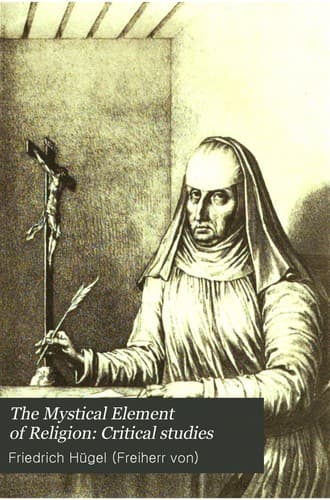
The Mystical Element of Religion, as studied in Saint Catherine of Genoa and her friends, Volume 2 (of 2)Hügel, Friedrich, Freiherr von
Religion
The Mystical Element of Religion, as studied in Saint Catherine of Genoa and her friends, Volume 2 (of 2)
Hügel, Friedrich, Freiherr von
Catherine, of Genoa, Saint, 1447-1510
I propose, then, in this chapter, to take, as separately as is
compatible with such a method, the temperamental, psycho-physical side
of Catherine’s life. I shall first take those last thirteen years
of admitted illness, as those which are alone at all fully known to
us by contemporary evidence.--I shall then make a jump back to her
first period,--to the first sixteen years up to her marriage, with
the next ten years of relaxation, and the following four years of
her conversion and active penitence. I take these next, because,
of these thirty years, we have her own late memories, as registered
for us by her disciples, at the time of her narration of the facts
concerned.--And only then, with these materials and instruments thus
gathered from after and before, shall I try to master the (for us
very obscure) middle period, and to arrive at some estimate of her
temperamental peripheral condition during these twenty years of her
fullest expansion.--I shall conclude the chapter by taking Catherine
in her general, lifelong temperament, and by comparing and contrasting
this type and modality of spiritual character and apprehension with the
other rival forms of, and approaches to, religious truth and goodness
as these are furnished for us by history.
The ultimate metaphysical questions and valuation are reserved for the
penultimate chapter of my book.
I. CATHERINE’S THIRD PERIOD, 1497 TO 1510.
1. _Increasing illness of Catherine’s last years._
Beginning with her third and last period (1497-1510), there can be no
doubt that throughout it she was ill and increasingly so. Her closest
friends and observers attest it. It is presumably Ettore Vernazza who
tells us, for 1497, “when she was about fifty years of age, she ceased
to be able to attend either to the Hospital or to her own house, owing
to her great bodily weakness. Even on Fast-days she was obliged, after
Holy Communion, to take some food to sustain her strength.” Probably
Marabotto it is who tells us that, in 1499, “after twenty-five years
she could no further bear her spiritual loneliness, either because of
old age or because of her great bodily weakness.” We hear from a later
Redactor that, “about nine years before her death (_i.e._ about 1501),
there came to her an infirmity.” And then, especially from November
1509, May 1510, and August 1510 onwards, she is declared and described
as more and more ill.[12] Indeed she herself, both by her acts and by
her words, emphatically admits her incapacitation. For it is clearly
ill-health which drives her to abandon the Matronship and even all
minor continuous work for the Hospital. In her Wills we find indeed
that, as late as May 21, 1506, she was able to get to the neighbouring
Hospital for Incurables; and that even on November 27, 1508 she was
“healthy in mind and body.” But her Codicil of January 5, 1503, was
drawn up in the presence of nine witnesses at midnight,--a sure sign of
some acute ill-health.
Public-domain text, read in full here on John Shaqi.
Reviews
Reviews
No reviews yet
Be the first to share your thoughts on this work.
Join the Discussion
Join the discussion
Sign in to leave a comment or review.
Sign InorCreate an account