VI. The Unitive State 148
Bibliography 169
Index 173
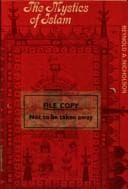
THE MYSTICS OF ISLAM
INTRODUCTION
The title of this book sufficiently explains why it is included in a
Series ‘exemplifying the adventures and labours of individual seekers
or groups of seekers in quest of reality.’ Sūfism, the religious
philosophy of Islam, is described in the oldest extant definition
as ‘the apprehension of divine realities,’ and Mohammedan mystics
are fond of calling themselves _Ahl al-Haqq_, ‘the followers of the
Real.’[1] In attempting to set forth their central doctrines from
this point of view, I shall draw to some extent on materials which
I have collected during the last twenty years for a general history
of Islamic mysticism--a subject so vast and many-sided that several
large volumes would be required to do it anything like justice. Here
I can only sketch in broad outline certain principles, methods, and
characteristic features of the inner life as it has been lived by
Moslems of every class and condition from the eighth century of our
era to the present day. Difficult are the paths which they threaded,
dark and bewildering the pathless heights beyond; but even if we
may not hope to accompany the travellers to their journey’s end,
any information that we have gathered concerning their religious
environment and spiritual history will help us to understand the
strange experiences of which they write.
[1] _Al-Haqq_ is the term generally used by Sūfīs when they refer to
God.
In the first place, therefore, I propose to offer a few remarks on the
origin and historical development of Sūfism, its relation to Islam,
and its general character. Not only are these matters interesting
to the student of comparative religion; some knowledge of them is
indispensable to any serious student of Sūfism itself. It may be said,
truly enough, that all mystical experiences ultimately meet in a single
point; but that point assumes widely different aspects according to the
mystic’s religion, race, and temperament, while the converging lines
of approach admit of almost infinite variety. Though all the great
types of mysticism have something in common, each is marked by peculiar
characteristics resulting from the circumstances in which it arose and
flourished. Just as the Christian type cannot be understood without
reference to Christianity, so the Mohammedan type must be viewed in
connexion with the outward and inward development of Islam.
Public-domain text, read in full here on John Shaqi.
Reviews
Reviews
No reviews yet
Be the first to share your thoughts on this work.
Join the Discussion
Join the discussion
Sign in to leave a comment or review.
Sign InorCreate an account