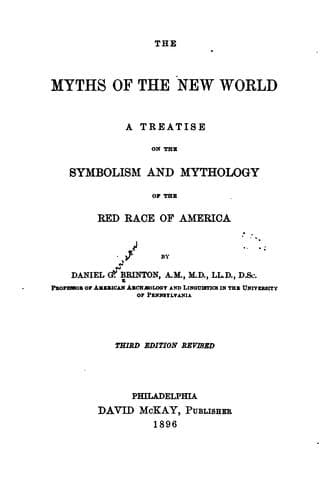
The Myths of the New World: A Treatise on the Symbolism and Mythology of the Red Race of AmericaBrinton, Daniel G. (Daniel Garrison)
Religion
The Myths of the New World: A Treatise on the Symbolism and Mythology of the Red Race of America
Brinton, Daniel G. (Daniel Garrison)
Indian mythology; Indians -- Folklore
As the path to a higher life hereafter, the burning of the dead was
first instituted. It was a privilege usually confined to a select few.
Among the Algonkin-Ottawas, only, those of the distinguished totem of
the Great Hare, among the Nicaraguans none but the caciques, among the
Caribs exclusively the priestly caste, were entitled to this peculiar
honor.[145-1] The first gave as the reason for such an exceptional
custom, that the members of such an illustrious clan as that of Michabo,
the Great Hare, should not rot in the ground as common folks, but rise
to the heavens on the flames and smoke. Those of Nicaragua seemed to
think it the sole path to immortality, holding that only such as offered
themselves on the pyre of their chieftain would escape annihilation at
death;[145-2] and the tribes of upper California were persuaded that
such as were not burned at death were liable to be transformed into the
lower orders of brutes.[145-3] Strangely, enough, we thus find a sort of
baptism by fire deemed essential to a higher life beyond the grave.
Another analogy strengthened the symbolic force of fire as life. This is
that which exists between the sensation of warmth and those passions
whose physiological end is the perpetuation of the species. We see how
native it is to the mind from such coarse expressions as "hot lust," "to
burn," "to be in heat," "stews," and the like, figures not of the
poetic, but the vulgar tongue. They occur in all languages, and hint how
readily the worship of fire glided into that of the reproductive
principle, into extravagances of chastity and lewdness, into the
shocking orgies of the so-called phallic worship.
Some have supposed that a sexual dualism pervades all natural religions
and this too has been assumed as the solution of all their myths. It has
been said that the action of heat upon moisture, of the sun on the
waters, the mysteries of reproduction, and the satisfaction of the
sexual instincts, are the unvarying themes of primitive mythology. So
far as the red race is concerned, this is a most gratuitous assumption.
The facts that have been eagerly collated by Dulaure and others to
bolster such a detestable theory lend themselves fairly to no such
interpretation.
There existed, indeed, a worship of the passions. Apparently it was
grafted upon or rose out of that of fire by the analogy I have pointed
out. Thus the Mexican god of fire was supposed to govern the generative
proclivities,[146-1] and there is good reason to believe that the sacred
fire watched by unspotted virgins among the Mayas had decidedly such a
signification. Certainly it was so, if we can depend upon the authority
of a ballad translated from the original immediately after the conquest,
cited by the venerable traveller and artist Count de Waldeck. It
purports to be from the lover of one of these vestals, and referring to
her occupation asks with a fine allusion to its mystic meaning--
Public-domain text, read in full here on John Shaqi.
Reviews
Reviews
No reviews yet
Be the first to share your thoughts on this work.
Elsewhere in the archive
Join the Discussion
Join the discussion
Sign in to leave a comment or review.
Sign InorCreate an account